
Ahnsbeck set to become a geothermal showcase project for Lower Saxony, Germany

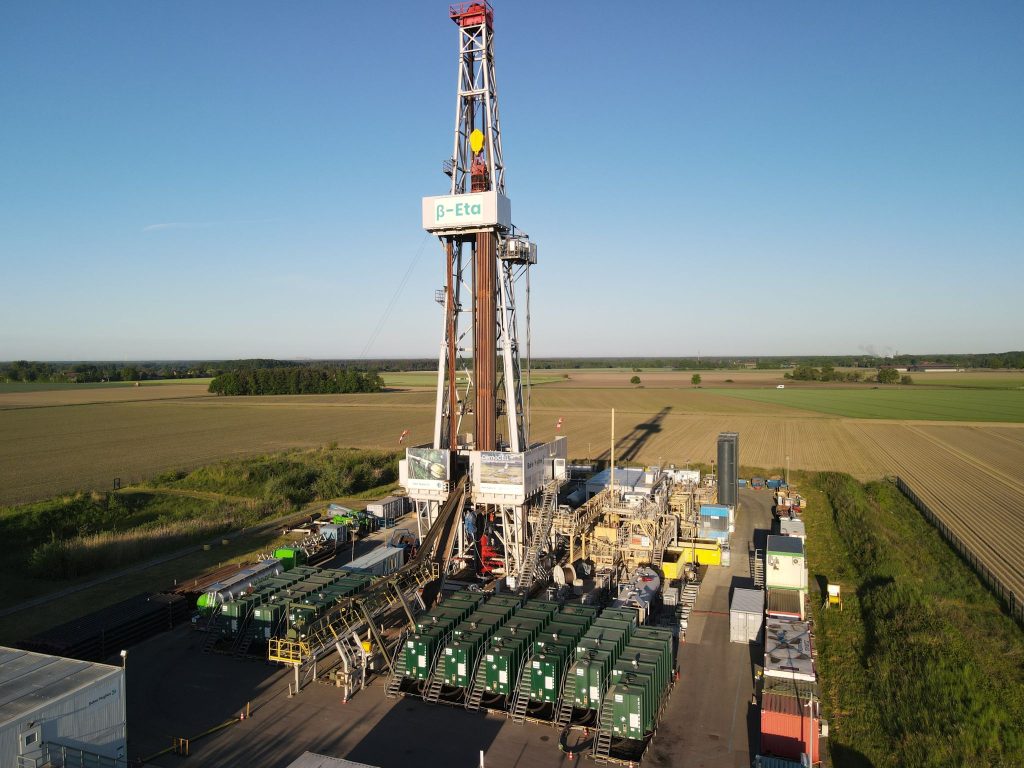
After drilling and well testing, the Ahnsbeck project is positioned to be the showcase for deep geothermal in Lower Saxony, Germany.
After drilling and extensive well testing, the DemoCELL project in Ahsnbeck is now considered the most advanced and successful deep geothermal project in the State of Lower Saxony in Germany. Geothermal resources with a temperature of 113 °C at a depth of 2500 meters have been verified, and will soon be harnessed for district heating.
“Nowhere in Lower Saxony are we as advanced as we are here,” Carsten Mühlenmeier, President of the State Office for Mining, Energy and Geology (LBEG) said during a visit to the drilling rig near Ahnsbeck. The DemoCELL project is a collaboration between the Georg-August University of Göttingen and Baker Hughes. The study site is part of a geothermal exploration license area awarded to Baker Hughes back in 2023 by the LBEG.
An exceptional quality of geothermal resources
As Dr. Oliver Höhne, project manager at Baker Hughes, explains, only 75 °C is expected at depths of 2500 meters under average conditions. Through the various tests and studies done by the experts at Baker Hughes on the study site, they had already expected that they were standing on a hot spot.
Dr. Matthias Franz from the University of Göttingen further explains that the geothermal resources are hosted in a 40-meter-thick layer of the Rhät sandstone. The reservoir formation at this site was of exceptionally high quality, and it was unlikely that such conditions can be found just a few kilometers to the south. The same formation corresponds to that found in Mecklenburg-Western Pomerania, where the deep geothermal projects in Waren an der Müritz and Neustadt-Glewe have been successfully supplying geothermal energy 1984 and 1994, respectively.
The potential for district heating
Holger Schwenke, Managing Director of Stromversorgung Osthannover Holding GmbH (SVO) assures that households in Celle will be supplied with heat from geothermal in the future. However, the surrounding towns of Ahnsbeck and Lachendorf will have to be connected to the source first. Waste heat from the paper mill can then be used to boost the heat supply to bridge the 12-kilometer distance to Celle. There is substantial heat demand in Celle, particularly in the medieval town center.
Schwenke further explained that the company is now just waiting for funding approval from the Federal Ministry of Economics
A strong push for geothermal in Lower Saxony
“We have now issued 42 permits for geothermal exploration, 32 of them in Lower Saxony,” explains Mühlenmeier. Aside from Lower Saxony, the agency has also granted seven permits in Schleswig-Holsten, two in Bremen, and one in Hamburg. All these territories are also within the authority of the LBEG.
The permits granted by LBEG grants companies the right to search for geothermal resources. However, the discovery risk remains a hurdle at this stage, especially if deep geothermal resources are being targeted. However, this is no longer the case in Ahnsbeck following the drilling and well testing phases. “There’s now almost unlimited energy available here,” explains Mühlenmeier. “Ahnsbeck can become a showcase project.”
In addition to its role as a mining authority, the LBEG is also the Lower Saxony Geothermal Service (NGD), which provides technically neutral and economically independent advice on near-surface and deep geothermal energy and creates and maintains geoscientific fundamentals
Source: LBEG