
AI and specialist journalism: Where to draw the line?

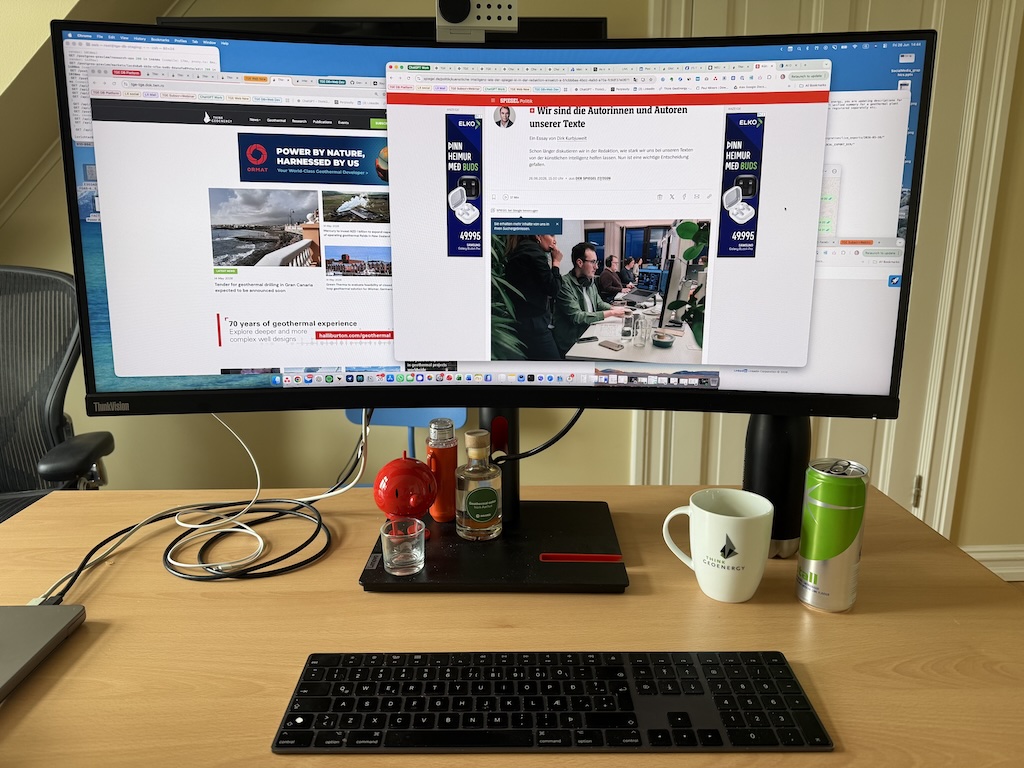
As AI reshapes journalism, specialist media face difficult choices. At ThinkGeoEnergy, we are still defining where assistance ends and editorial judgement begins.
An editorial article published today in Germany’s DER SPIEGEL immediately and strongly resonated with me and motivated me to write this short piece here ahead of the weekend.
The article has been a super interesting reading and take on how a media platform should deal with AI, what it can do and where its limitations are, or which limitations we should set ourselfs as media platforms. The theme circles around journalism, trust and responsibility.
The article describes an internal meeting and debate at The SPIEGEL that many editorial teams are now having: if AI can summarize, translate, restructure and even produce convincing articles, where should journalists draw the line? The conclusion by the team at the SPIEGEL was clear, AI should remain a tool. Thinking, judgement and responsibility should stay with people. So a decision to keep authorship with journalists while still allowing AI as a supporting tool.
This resonated so strongly with me today, as it clearly is not just a debate for major news organisations. Every specialist publisher, just like ThinkGeoEnergy, is beginning to face exactly the same questions … and for specialist media this is a huge challenge.
The challenge of too much information
While information is growing exponentially with press releases, research papers, government documents, conference presentations and papers, LinkedIn, videos, podcasts, webinars and academic publications, it becomes increasingly difficult to stay on top it all.
For now more than 17 years, ThinkGeoEnergy has provided free coverage of global geothermal development around the world. Like many specialist publications, however we operate with a small editorial team supported by advertisers. We cannot simply hire ten more journalists and the same applies to our data intelligence research. So AI has become extremely useful for navigating this information and ignoring these tools would be unrealistic. With that though, another problem is emerging.
Information is becoming abundant. Insight may become more scarce.
AI is making it much easier than ever to create content and that quickly. We see that social media posts increasingly feel repetitive, similar, polished and strangely impersonal.
Articles often start looking different but saying the same, LinkedIn posts are becoming strangely similar in style and emphasis. With the support of AI – and this applies to me as well – everyone is becoming more productive, but is everyone becoming really more insightful?
Information is becoming more and more abundant,
Insight may actually become more scarce.
This represents a real dilemma and leaves us with some uncomfortable questions:
- When does assistance become dependence?
- How much of AI is too much?
- If every article starts from an AI draft, what happens to individual writing styles?
- Will readers continue to distinguish between expertise and well-written summaries?
- Does faster necessarily mean better?
Where does ThinkGeoEnergy stand today?
Well, we still are very much discussing this internally and certainly use AI. But we also believe that editorial judgement remains essential. Technology should help us understand more, yet it should not replace curiousity, questioning, experience and accountability.
We do not have an answer yet and our thinking around AI, journalism and our work continues to evolve.
Why this matters for geothermal
Geothermal energy is a highly technical industry for which context matters greatly. Small differences in wording often have major technical implications. Of course, specialist publications like ours do not always get everything right. We certainly don’t. But accuracy is only part of our responsibility. Readers though reply on specialist publications not only for information but also for perspective. That is clearly a responsibility that becomes even greater as AI-generated content becomes more common.
It is clear we do not yet have all the answers surrounding AI, its use and future and I suspect many others (if not all of us) are asking themselves the same questions. This conversation is just beginning.
I would genuinly like to hear how others in geothermal, journalism, consulting and research are approaching AI in their daily work. Feel free to connect with me on LinkedIn or reach out directly at alex@thinkgeoenergy.com.