
Baseload Capital continues geothermal ambition with more focused strategy

Baseload Capital names Erik Brandberg CEO and shifts to a leaner model focused on local developers, selective investment, and capital discipline.
Baseload Capital has appointed Erik Brandberg as Chief Executive Officer and announced a shift towards a leaner, more locally anchored operating model, marking a notable change in direction for one of the geothermal sector’s most visible investment platforms.
Brandberg succeeds Alexander Helling, who co-founded Baseload and has led the company since its early years. In its release shared August 19, 2026, Baseload said it will concentrate resources on markets offering the clearest path to long-term value creation, work increasingly with established local developers and partners, and reduce the size of its central organization.
The company also pointed to a material change in the market for growth capital in recent years as a reason for adapting its cost base and the way it allocates resources.
Beginnings as a geothermal financing vehicle
The company was established in early 2018 by Swedish family-owned investment companies Gullspång Invest, Blue, and LMK Forward in cooperation with Climeon, which also held a minority stake. At the time, the stated purpose of founding the company was to invest in and provide financing for geothermal development.
Through the years, Baseload secured support from several prominent investors. Breakthrough Energy Ventures invested USD 12.5 million in Baseload in March 2019. In 2021, Baseload completed a USD 25 million equity financing round that brought Chevron Technology Ventures in as a strategic investor.
A further step came in September 2024, when Baseload raised EUR 53 million in a Series B financing round. The round was led by ENGF, whose main investor is Ingka Investments, with participation from Baker Hughes, NEFCO, Breakthrough Energy Ventures and Gullspång Invest.
Evolution and progress in development
Baseload subsequently evolved well beyond its initial investment role. The company established operations in Japan, Taiwan, Iceland and the United States and developed into a broader geothermal investment and development platform.
In Taiwan, Baseload and Google announced a 10 MW corporate power purchase agreement in 2025. The agreement also included a direct equity investment by Google in Baseload Capital, with the projects expected to come online in 2029. The deal was also described as Google’s first geothermal PPA in the Asia-Pacific region.
In Japan, Baseload announced a strategic investment in local geothermal developer Furusato Netsuden in September 2025. That relationship is relevant to the direction now outlined by Baseload. Rather than building an entirely new local development organization, Baseload is investing alongside an established developer with existing community relationships and project experience.
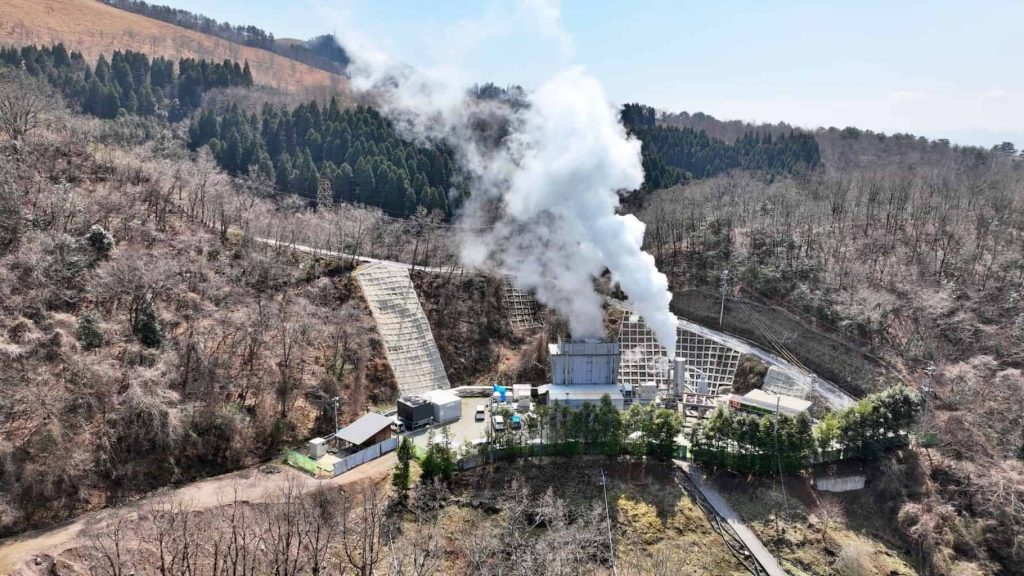
Furusato Netsuden and local partner Waita-kai LLC subsequently brought the 4.995 MW Waita No. 2 geothermal power plant into commercial operation on March 2026.
A shift that reflects geothermal realities
The new strategy is a reflection of scaling geothermal businesses. Geothermal does not expand in quite the same way as many other clean-energy technologies. Each market brings its own resource characteristics, permitting processes, drilling requirements, community relationships, power-market structures and project risks. Those factors make international expansion possible, but difficult to standardize.
Baseload itself acknowledged this challenge several years ago. In March 2022, the company stated that the “roll-out of new plants is slower than planned,” while continuing to advance projects across several international markets. ThinkGeoEnergy covered that update here. That observation appears particularly relevant in light of the strategy announced this week.
The move towards working with established local developers rather than building substantial organizations around each opportunity is less of a retreat from geothermal than a reassessment of how geothermal development can be scaled. Local developers often hold much of what cannot easily be replicated from a central platform: resource knowledge, permitting experience, community relationships, local partnerships and an understanding of national energy markets.
Capital patience remains a central issue
Baseload has been particularly active in communicating the geothermal opportunity. Its activities have included webinars, podcasts, educational initiatives and industry communication projects. In 2024, Baseload Capital launched GeoTV, a video format focused on geothermal news and discussion, and ThinkGeoEnergy had partnered with Baseload on this until September 2025.
Baseload has also played a leading role in calling for unified communication across the geothermal industry through the Declaration of Communication. Through a series of children’s books, the communication work done by Baseload extended to a wider audience with art and storytelling.
Those activities helped contribute to geothermal’s broader visibility, complementing an ambitious international development strategy. However, visibility and access to capital cannot remove the physical and regulatory realities of geothermal development. Exploration takes time, drilling carries risk, and permitting can take years. Projects depend heavily on local conditions, and considerable capital may be deployed before the quality of a resource is fully understood.
For investors accustomed to faster-growing technology sectors, this can create a mismatch between expectations for growth and the pace at which geothermal projects can realistically be developed.
Baseload’s shift therefore provides a useful case study for the wider industry. It does not suggest that the geothermal opportunity has weakened. Recent developments including the Google agreement in Taiwan and the progress of Furusato Netsuden in Japan point in the opposite direction. What it does suggest is that the organizational model surrounding geothermal investment matters almost as much as the availability of capital itself.
“Our focus now is to build on that foundation while becoming more strategic in how and where we deploy our resources,” Brandberg said. The new CEO has been part of the journey of Baseload since the beginning, and represents the continued support of the company’s long-term owners through this transition.
A smaller central organization, stronger reliance on local developers, and greater selectivity in deploying capital may ultimately prove better suited to a sector where growth tends to be incremental rather than exponential, and highly dependent on local conditions. For the geothermal sector, the more interesting question will now be whether Baseload’s more focused model can convert its investment experience, international network, and existing portfolio into a more capital-efficient pipeline of operating projects.