Drilling in Krefeld, Germany identifies deep geothermal reservoir

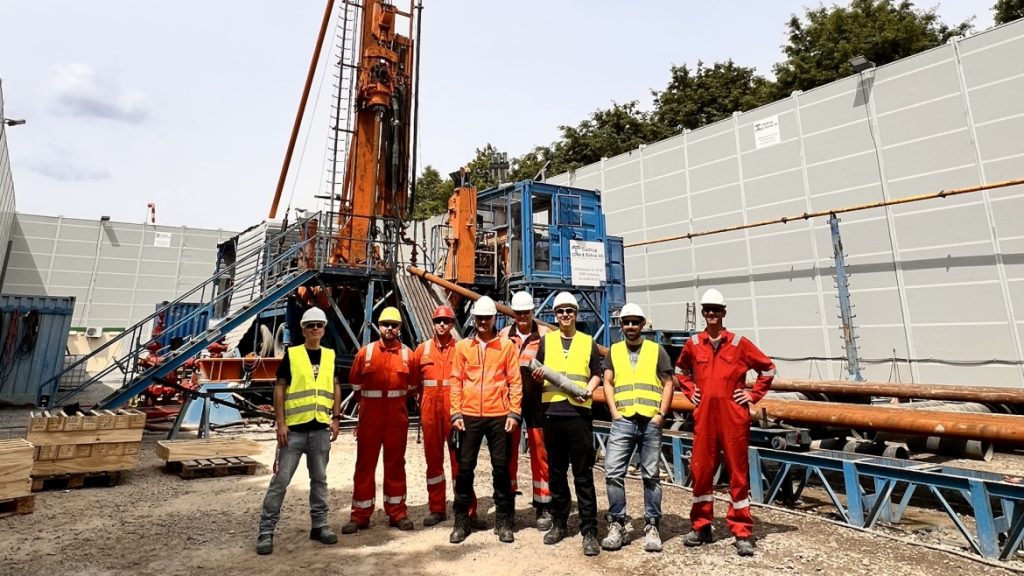
Research drilling in Krefeld, Germany has been completed, with tests indicating that the geothermal reservoir is thicker and more productive than expected.
The drilling and testing of a geothermal research well in the city of Krefeld in North Rhine-Westphalia Germany have now been almost completed, and early results are promising. The postulated limestone host of the geothermal resource was successfully drilled into, and was found to be much thicker than initially thought.
Drilling started in March 2025 and continued for 73 days and nights without interruption, reaching a depth of 957 meters. The aim of the well is to penetrate into and characterize the Kohlenkalk, a limestone formation from the Carboniferous period.
After four weeks of drilling, the Kohlenkalk was reached at a depth of 380 meters. A pleasant surprise came when the well intersected the base of the Kohlenkalk at 944 meters, which is much deeper than the postulated depth of 725 meters. This means that the host rock is thicker than expected, thus also increasing the potential for geothermal utilization at the site. Subsequent hydraulic tests also confirmed that more water can be pumped from the borehole than initially expected.
Nearly 667 meters of core samples were collected from the wellbore, and the analysis of these samples is still ongoing. As project leader Ingo Schäfer explains: “They tell us a lot about the carbon limestone, its reservoir properties, and the geological processes that formed it. The new findings are applicable to the entire region—and this is precisely the information we need to professionally assess the potential for the safe and sustainable use of deep geothermal energy.”
The drilling is part of the statewide exploration and drilling program “Geowärme – Wir erkunden NRW.” This program is being implemented as part of the NRW Geothermal Master Plan, published in 2024 by the Ministry of Economic Affairs, Industry, Climate Protection and Energy of the State of North Rhine-Westphalia. The goal of the program is to explore deep-lying heat deposits in North Rhine-Westphalia in order to cover around 20 percent of the heat demand with climate-friendly geothermal energy by 2045.
According to the Geological Survey of North Rhine-Westphalia, the next deep research drilling is already planned for early 2026 in Cologne-Dellbrück.
What happens to the drilling site?
Anyone wishing to explore and extract geothermal energy from depths of over 400 meters in Germany requires a corresponding mining permit. Exempt from this are drilling operations carried out as part of the state’s geoscientific survey, such as the one conducted by the GD NRW in Krefeld.
The temporary research well does not meet the technical and legal requirements for a permanent production well. Therefore, the borehole will be backfilled according to regulations, and the drilling site will be completely dismantled. The parking lot will then be fully accessible again.
Source: Geowärme Wir erkunden NRW