
Enogia repurposes idle geothermal wells with compact ORC


French company Enogia develops compact ORC systems to generate electricity from underused and low-enthalpy geothermal wells worldwide.
French company Enogia is entering the geothermal sector with small-scale Organic Rankine Cycle (ORC) units designed to generate electricity from low-temperature and underutilised wells.
With two decades at Ormat behind him, Gadi Shoshan knows the geothermal industry’s evolution well. Now advising French technology company Enogia, he sees an opportunity in a segment long overlooked, the vast number of geothermal wells that remain idle or mismatched with main power plant requirements, as well as the ones delivering too hot a resource for district heating or other applications.
“Many wells are simply not connected because their temperatures are too low to fit the majority of the field for the central plant,” said Shoshan. “Enogia’s compact ORC systems can turn these wells into productive assets, generating power from as low as 70 °C.” With the investment already made for these wells, it is usually regarded as sunken cost. Now it can be recovered with minor additional investment. With well wellhead unit, one can also save the inlet gathering system cost.
Compact design for flexible deployment
Enogia’s sealed ORC units, developed and assembled in France, integrate the turbine and generator in a single enclosure rotating at up to 30,000 rpm. The design, originally used in waste heat recovery, allows for quick installation and minimal maintenance. Units range from 10 kW to 200 kW single units, which can be stacked to achieve higher capacities. In a South Korean fuel cell site Enogia delivered 2MW production system by recuperating the fuel cell waste heat.
The technology’s flexibility also opens opportunities beyond geothermal power plants. Shoshan pointed to district heating networks, where surplus heat often over 80 – 90°C is often wasted. “Instead of cooling that heat down, operators can generate electricity for internal use or grid injection,” he said.
Market focus and growing project base
Enogia, listed on the French stock exchange, employs around 70 engineers and has installed more than 200 systems in industrial and marine waste heat recovery. Its geothermal portfolio is expanding, with projects in Iceland, Japan, China, and Taiwan already operational or underway. Enogia’s geothermal portfolio is expanding, and with the growing interest in their solution, we witnessed at the GRC, it is for sure to continue. As they are only doing first steps into the geothermal market, only few first test cases were performed, all of which with great success –
In Iceland, the company’s system was installed at Krauma, the geothermal spa fed by Deildartunguhver hot spring. We previously reported on it. There, a compact 40kWe ORC unit generates electricity from the spa’s geothermal water stream, demonstrating how small-scale power recovery can integrate seamlessly into direct-use operations.


In Japan, the Shimane case, recently commissioned and fully operational, started as a test case for onsen-type geothermal wells. ENOGIA was evaluated as the most compact and highest expected performance, as well as the lowest in cost maintenance system. On top of the heat generated for the Onsen, power generation performance was considered most important. The 20 kWe performance of ENOGIA was roughly 5-8% higher than any other competitor.


In Vermilion, south of France, an abandoned oil well was successfully installed with 20 kWe Enogia well-head system that can be mobilized easily.

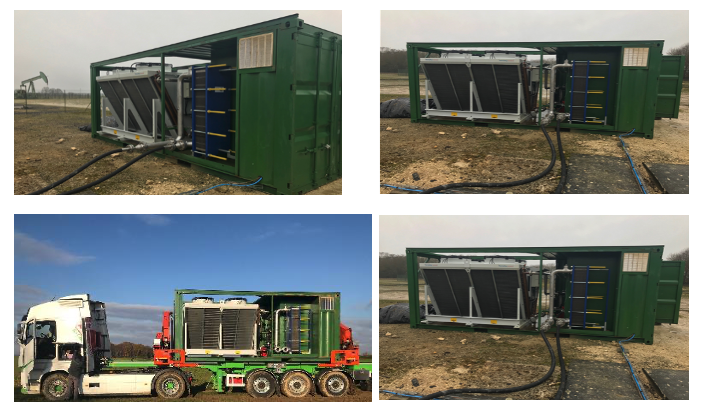
These projects serve as a real-world example of how Enogia’s units can improve energy efficiency in low-enthalpy settings while supporting on-site power use. The company currently focuses on selling equipment rather than developing projects, a strategy Shoshan believes will help establish its market presence before deeper partnerships emerge.
Enogia’s target clients include geothermal operators with abandoned wells, district heating utilities seeking efficiency gains, and oil and gas companies repurposing warm water wells. “These are known resources with sunken costs. We can help extract more value without drilling new wells or constructing additional gathering systems,” Shoshan explained.
Engineering culture and future outlook
Shoshan compared Enogia’s team to the early years of Ormat: “innovative, agile, and deeply technical.” He credited the company’s culture of engineering excellence as a key reason for joining after retirement. “I wanted to work with people who genuinely enjoy solving problems in new ways,” he said.
While enjoying more time with family and gardening, Shoshan remains driven by the potential of geothermal energy. “There’s still so much untapped value in existing wells. Helping unlock that potential feels both rewarding and necessary,” he concluded.