
GeoMap Middle East highlights geothermal potential for cooling and storage in Gulf Region

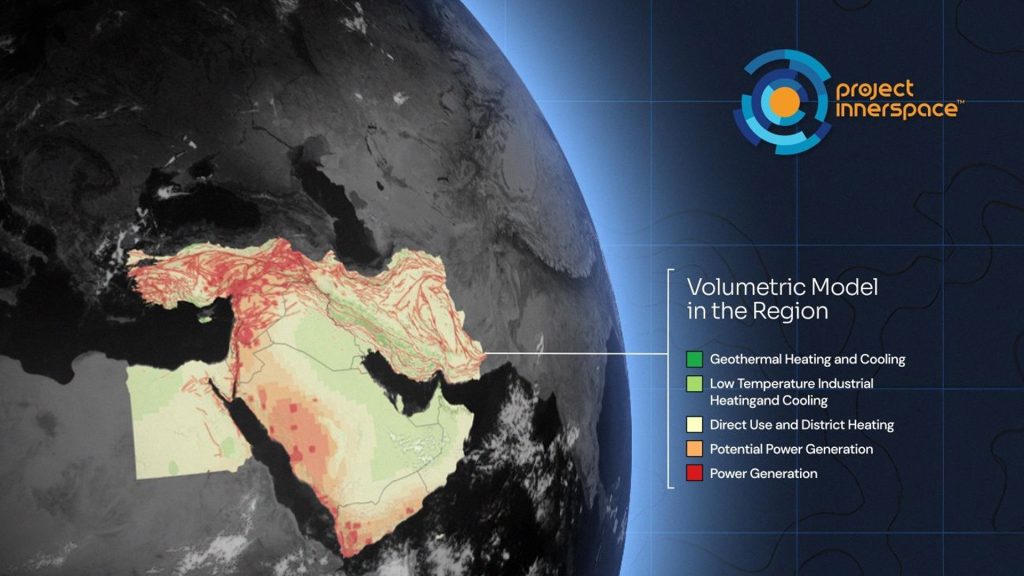
Project InnerSpace has launched GeoMap Middle East, highlighting the potential of geothermal for district cooling and subsurface storage in the Gulf Region.
Project InnerSpace has announced the launch of GeoMap™ Middle East, a geothermal exploration tool the showcases the potential of geothermal in the Gulf region for cooling, long-duration energy storage, and power applications. The latest release adds to the growing coverage of the GeoMap tool spanning across Africa, North America, India, Asia, and Oceania.
Advances in drilling and subsurface technologies are making geothermal affordable and scalable in regions once thought inaccessible, like the Middle East. Geothermal has the potential play a special role in the region, as it can provide the constant, low emissions energy needed to meet rising demand for cooling in some of the world’s hottest, fastest-growing cities. It can also complement record-breaking solar investments by providing long-duration energy storage.
More importantly, the Middle East is uniquely positioned to scale geothermal quickly, given the region’s decades of drilling expertise and robust oil and gas industry presence, providing the know-how, workforce, and assets needed for rapid deployment.
The initial findings of GeoMap in the Gulf Region identify:
- Urban cooling applications. In Gulf States, cooling accounts for about 70% of peak electricity demand. Geothermal district cooling could ease grid strain in cities like Riyadh, Doha, and Dubai. GeoMap shows a potential of ~14,000 GW of cooling with Iran, Egypt, Iraq, and Turkey indicating major opportunities, and Saudi Arabia, UAE, and Qatar following.
- Subsurface storage opportunities. Geological formations across Iraq, Syria, the Gulf states, northern Saudi Arabia, and Yemen can store excess energy from solar and wind facilities in deep sedimentary basins, which can then be released to balance the demand of intermittent renewables.
- High-potential geothermal zones. The Red Sea Rift (western Saudi Arabia/northern Yemen) holds potential for gigawatt-scale power production and desalination; eastern Turkey and northern Iran also have strong power potential. There is potential to build geothermal-powered data centres in both areas.
“One of the most exciting things about the geothermal development potential in the Gulf region is the fact that the resource sits below some of the world’s most capable and resourced oil and gas companies – the very entities with the required expertise to develop these resources, and the ability to deliver the speed and scale necessary to make geothermal relevant for the world,” said Jamie Beard, Executive Director of Project InnerSpace.
RELATED: First geothermal cooling plant in Masdar City, UAE starts operations