
New technologies are reshaping the potential of geothermal energy. While conventional hydrothermal systems continue to power and heat communities around the world, the next generation of geothermal technologies is opening access to deeper, hotter, and previously inaccessible resources. These systems – ranging from engineered reservoirs to closed-loop and supercritical concepts – are pushing geothermal energy far beyond its traditional boundaries.
This chapter introduces five of the most discussed “advanced geothermal” approaches: Enhanced/Engineered Geothermal Systems (EGS), Advanced/ Closed-Loop Systems (AGS), Supercritical Geothermal, Geo-Pressured Resources, and Oil & Gas Co-production. Each represents a different pathway for expanding the geothermal landscape and solving longstanding challenges around scalability, siting, and cost.
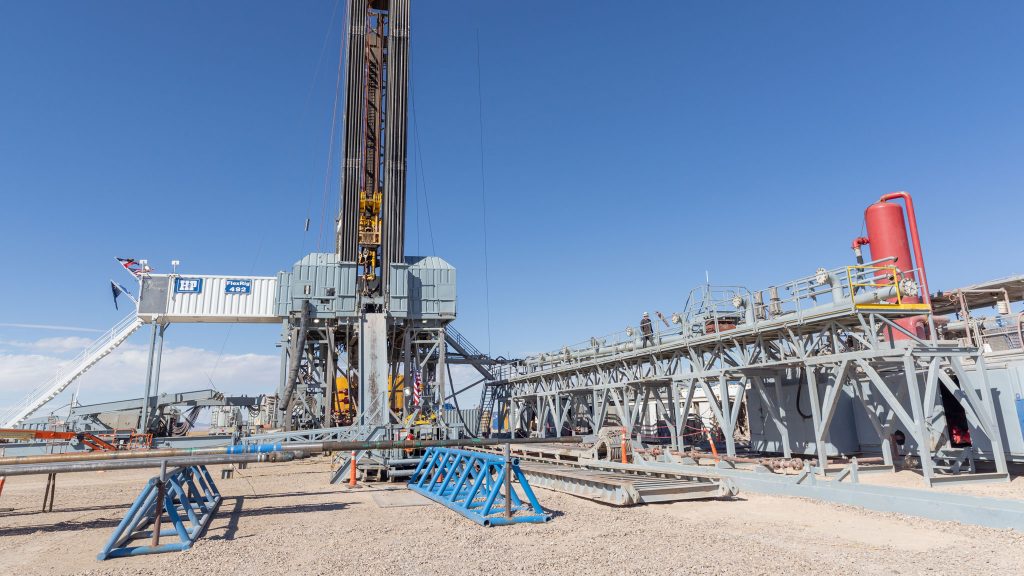
Picture source: Rig operations at the Cape site in Utah (source: Fervo Energy)
Overview on conventional & unconventional geothermal development alternatives
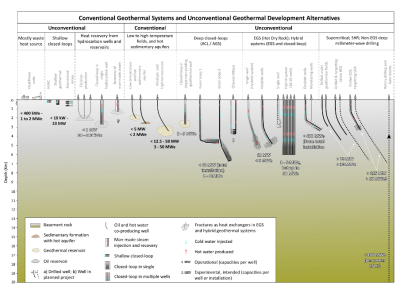

Source: Khodayar, M. and Björnsson, S. (2024) Conventional Geothermal Systems and Unconventional Geothermal Developments: An Overview. Open Journal of Geology, 14, 196-246. https://doi.org/10.4236/ojg.2024.142012
Graphic file:
Enhanced / Engineered Geothermal Systems (EGS)
Concept and Mechanism
EGS systems are based on the creation of artificial geothermal reservoirs in hot dry rock – or in low-permeability formations where natural hydrothermal circulation is insufficient. Through hydraulic stimulation, permeability is enhanced by creating fractures or reopening existing ones. Water is injected into one or more wells, heated by contact with the surrounding hot rock, and then produced back to the surface for energy use. These systems are typically located in areas without naturally occurring high-temperature fluid reservoirs.
In some cases, EGS techniques are also applied in “hybrid” fashion to enhance productivity in marginal hydrothermal settings – such as the Landau project in Germany.
Benefits and Challenges
EGS offers the promise of extending geothermal access to nearly any region with sufficient heat at depth, regardless of natural fluid availability. However, the technique is capital-intensive and involves significant technical and social challenges. The risk of induced seismicity from stimulation activities has led to concerns in populated regions. Sustaining long-term fluid circulation and maintaining reservoir performance remain key technical hurdles.
Case Studies
- Fervo Energy (USA): Demonstrated horizontal drilling and fiber-optic monitoring to enhance EGS well performance. Link: https://www.fervoenergy.com/
- Soultz-sous-Forêts (France): One of Europe’s longest-standing EGS pilot sites. Link: https://cordis.europa.eu/project/id/502706/reporting
- Cooper Basin (Australia): Deep granitic system in a hot dry rock setting by Geodynamics. Link: https://arena.gov.au/projects/cooper-basin-enhanced-geothermal-systems-heat-and-power-development/
- Cornwall (UK): The Rosemanowes HDR project experimented in Hot Dry Rock reservoir creation. Link: https://www.sciencedirect.com/science/article/pii/S0375650599000310
Figure: Enhanced/ Engineered Geothermal Systems in hot (dry) rock
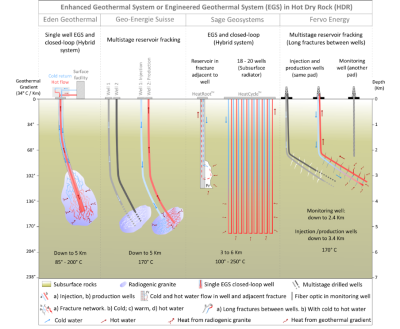

Figure: Unconventional geothermal developments: Enhanced or Engineered Geothermal Systems (EGS) in hot dry rock between 3 Km and 6 Km depth. The method uses mostly fracking to create fractures as natural heat exchangers in rock or adjacent well. The hybrid system uses both EGS and closed-loop as subsurface radiator. It can also be applied to stimulate limited permeability rock in conventional geothermal development
Source: Khodayar, M. and Björnsson, S. (2024) Conventional Geothermal Systems and Unconventional Geothermal Developments: An Overview. Open Journal of Geology, 14, 196-246. https://doi.org/10.4236/ojg.2024.142012
Advanced / Closed-Loop Geothermal Systems (AGS)
Concept and Working Principle
Closed-loop systems – also called Advanced Geothermal Systems (AGS) – represent a fundamental shift from traditional geothermal. Rather than relying on natural permeability or fluid flow, these systems circulate a working fluid through sealed pipes embedded in hot rock. Heat is transferred conductively from the surrounding formation into the fluid, which is then used at the surface for heat or power generation. Because no reservoir fluids are extracted or injected, AGS avoids many of the geotechnical and regulatory risks associated with open-loop systems.
Key Technologies and Variants
AGS designs range from vertical single-well loops to multilateral horizontal configurations. Coaxial and thermosiphon systems are both in development, and several companies are testing alternative fluids, including supercritical CO?, to enhance heat transfer. Surface integration can support power generation or direct-use applications depending on the system scale and output temperature.
Case Studies
- Eavor Technologies (Canada): Eavor-Loop pilots have been tested in Alberta and are under development in Germany. Link: https://eavor.com/technology/
- GreenFire Energy (USA): Retrofitted a non-producing geothermal well at the Coso field into a closed-loop demonstration. Link: https://www.greenfireenergy.com/technology/
- Bedrock Energy (USA): Focused on modular shallow closed-loop systems for buildings and institutions. Link: https://bedrockenergy.com/#how-it-works
Figure: Deep Closed-Loops/ Advanced Closed-Loops/ Advanced Geothermal Systems
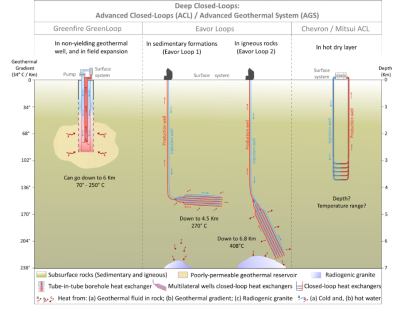

Figure: Unconventional geothermal alternatives developing down to 7 Km depth in sedimentary and igneous hot dry rocks. These deeper closed-loop technologies are intended for single well, for doublet injection/production wells and multiple boreholes.
Source: Khodayar, M. and Björnsson, S. (2024) Conventional Geothermal Systems and Unconventional Geothermal Developments: An Overview. Open Journal of Geology, 14, 196-246. https://doi.org/10.4236/ojg.2024.142012
Supercritical Geothermal Systems
What is Supercritical Fluid?
At temperatures above 374°C and pressures above 220 bar, water enters a “supercritical” state, where it behaves as both a liquid and gas. In this state, fluid has significantly higher enthalpy, enabling much more energy to be extracted per unit volume. Supercritical geothermal wells could potentially produce five to ten times the energy of a conventional well – provided the challenges of drilling and materials can be overcome.
Opportunities and Technical Challenges
Accessing supercritical zones requires deeper drilling and more robust well infrastructure. The extreme conditions place major demands on casing, pumps, and sensors. Scaling, corrosion, and unpredictable chemistry present additional operational risks. Nevertheless, if proven viable, supercritical systems could dramatically boost geothermal efficiency in volcanic regions.
Case Studies
- Iceland Deep Drilling Project (IDDP)/ Krafla Magma Testbed (KMT): At Krafla and Reykjanes, wells have reached supercritical conditions in active volcanic zones. Link (IDDP): https://iddp.is/ – Link (KMT): https://www.kmt.is/
- DESCRAMBLE/ Venelle-2 (Italy): Drilled to explore high-enthalpy supercritical resources in the Apennines.
- Mazama Energy (USA): Newberry site in Oregon focuses on high-heat potential (superhot Rock/ SHR Enhanced Geothermal System (EGS). Link: https://mazamaenergy.com/newberry/
- Others: GA Drilling and Quaise are exploring ultra-deep drilling; Hephae Energy is developing temperature-resistant surface equipment.
Figure: Power Density by Energy Source (watts per square meter) on log scale
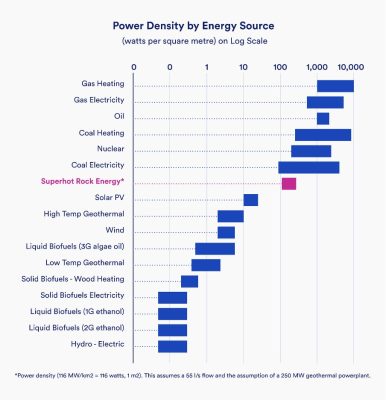

Source: Power density, capacity per square meter, of several fossil fuel and renewable energy sources (modified from Hampshire-Waugh, 2021). The size of the superhot rock power plant is assumed to be 250 MWe (as described by CATF, 2022a). Retrieved via CATF “Superhot Rock Glossary”, at https://www.catf.us/superhot-rock/glossary/
Geo-Pressured Resources/ Geothermal Systems
Definition and Resource Type
Geo-pressured geothermal systems exist in deep sedimentary formations where fluid is trapped under both high pressure and elevated temperature. These resources are typically found in petroleum-rich basins and consist of formation water confined under impermeable layers. The high pressure is a result of poor drainage and low permeability, which causes fluid to be compressed within the rock matrix over geological time.
A key distinction is that geo-pressured reservoirs contain not only thermal energy but also hydraulic (pressure) energy and often significant volumes of dissolved natural gas, particularly methane. This combination of energy types makes geo-pressured systems a form of multi-energy resource.
According to the Sage Geosystems technical concept, such systems are not defined by depth alone, but by the simultaneous availability of: reservoir temperature (typically 195–320°F / 90–160°C), high-pressure head (e.g., >1.0 psi/ft), and economically recoverable flow rates (e.g., >5,000 bbl/day from one or more wells).
Energy Potential
Geo-pressured systems offer a unique opportunity to extract three forms of energy:
- Thermal energy from hot fluids, suitable for binary cycle power generation or direct use
- Hydraulic energy via pressure drop between the formation and surface, recoverable through wellhead turbines or pressure recovery systems
- Chemical energy from dissolved methane, which can be separated and used as a fuel or feedstock
Because no stimulation is required and many sedimentary basins are well-characterized from decades of oil and gas exploration, geo-pressured systems may offer a lower-risk entry point for geothermal development—especially in areas without conventional hydrothermal resources.
Case Studies
- Sage Geosystems (USA): Actively developing hybrid systems in the Texas Gulf Coast combining thermal, hydraulic, and gas energy. Demonstrated multi-megawatt energy outputs from single wellbores. https://www.sagegeosystems.com/technology
- DOE Gulf Coast Pilots (1980s): Provided early data on reservoir productivity and technical feasibility.
- European Basins: North German and Po Basin (Italy) are considered promising for future development.
Figure: Geopressured Geothermal System
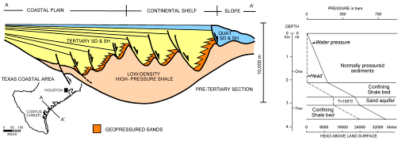

Source: Bebout, D G, et al. “Geothermal resources, Wilcox Group, Texas Gulf Coast.” (1978)
Oil & Gas Co-production and Synergies
Using Existing Infrastructure
Geothermal energy can also be extracted from the hot water produced during oil and gas operations, particularly in the late-life phase of oilfields. This approach reduces exploration and drilling costs by using existing wellbores and infrastructure. It also provides new life to mature assets and aligns with decarbonization goals within the hydrocarbon sector.
Technology Integration
Co-production systems often use small-scale binary Organic Rankine Cycle (ORC) units to convert thermal energy to electricity. In some configurations, brine may also be used for direct heating, water treatment, or – in select cases – mineral extraction (though this aspect is covered separately elsewhere in the overview series).
Case Studies
- Gradient Geothermal (USA): Integrating geothermal production into conventional oilfield operations. https://www.gradientgeothermal.com/#Advantages
- Razor Energy & Futera Power (Canada): Canada’s first co-produced geothermal power project, now operational. https://www.globenewswire.com/news-release/2023/03/22/2632687/0/en/Canada-s-First-Co-Produced-Geothermal-Power-Project-is-Operational.html
- Sage Geosystems (USA): Combining energy storage with thermal recovery from oil wells.
- Baker Hughes and SLB: Expanding geothermal capabilities using oilfield tools and data.
Figure: Heat Recovery from Hydrocarbon Wells and Reservoirs
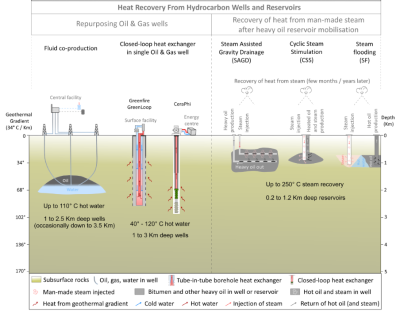

Figure: Unconventional geothermal development through heat recovery from hydrocarbon wells and reservoirs, applied from 0.2 Km to 3 Km depth. Methods range from fluid co-production from many hydrocarbon wells, to closed-loop in single well, and even recovery of heat from man-made steam after mobilising heavy oil in reservoir. Note that heights of hydrocarbon reservoirs are exaggerated for the purpose of drawing.
Source: Khodayar, M. and Björnsson, S. (2024) Conventional Geothermal Systems and Unconventional Geothermal Developments: An Overview. Open Journal of Geology, 14, 196-246. https://doi.org/10.4236/ojg.2024.142012
Summary Table: Technology Attributes
In km/ degrees Celsius
| Technology | Depth* | Temp Range | Fluid Required | Power/Heat Use | Main Challenge |
| EGS | 3-6 km | 150-250°C | Artificial | Power & heat | Seismicity (fracture integrity/stability), cost |
| AGS | 2-5 km | 100-200°C | Artificial in closed-loop | Heat & niche power | Drilling cost, economics, scalability |
| Supercritical | 4-6 km | >374°C | Natural | High-power | Well integrity & drilling complexity |
| Geo-pressured | 3-5 km | 90-160°C | Brine + gas | Hybrid | Low efficiency |
| O&G co-prod. | 2-4 km | 80-130°C | Brine | Retrofit power | Flow decline |
In feet/ degrees Fahrenheit
| Technology | Depth (ft)* | Temp Range | Fluid Required | Power/Heat Use | Main Challenge |
| EGS | 9,800-19,700 | 300-480°F | Artificial | Power & heat | Seismicity, cost |
| AGS | 6,500-16,400 | 210-390°F | Closed-loop | Heat & niche power | Economics, scalability |
| Supercritical | 13,100-16,400 | >705°F | Natural | High-power | Well integrity |
| Geo-pressured | 9,800-16,400 | 195-320°F | Brine + gas | Hybrid | Low efficiency |
| O&G co-prod. | 6,500-13,100 | 175-265°F | Brine | Retrofit power | Flow decline |
* Disclaimer on depth numbers: essentially EGS, AGS and supercritical technologies could also be applied in shallower depths if temperature levels and conditions allow for a technically and economically feasible project, so numbers mentioned here are general numbers of current development.