
Hungary publishes national strategy to double geothermal output by 2030


The Government of Hungary has published a National Geothermal Strategy to attain the goal of doubling geothermal energy utilization by 2030.
The Government of Hungary, thru the Ministry of Energy, has recently published a National Geothermal Strategy that outlines a path for the greater utilization of geothermal energy while setting out the framework for the use of state resources to support the agenda.
The full National Geothermal Strategy document can be accessed via this link.
The potential for geothermal in Hungary
Hungary currently has an annual geothermal production (including balneological use) reaching 9.0 PJ with an installed capacity of 1.02 GWt, more than 99% of which is used as thermal energy. About 6.4 PJ is used for energy. Geothermal accounts for 6.5% of the country’s gross heat production and is available in 11 settlements. There is currently only one geothermal power facility in Tura with an installed capacity of 2.7 MWe and 7.0 MWth.


Based on the available data, there is a theoretical maximum of geothermal energy of 55-60 PJ that can be extracted annually, and an additional potential of 130 PJ from underground storage. An important factor for the favorable geothermal setting of Hungary is the Carpathian Basin, composed of a sandy clay sedimentary series and deeper limestones and dolomites.
Another advantage of Hungary is that has a large body of subsurface research data coming from around 9000 boreholes drilled for hydrocarbon mining, 2D and 3D seismic data, nearly 4000 magnetotelluric soundings, the 1700 thermal wells that have been documented in detail, including water chemistry parameters.
Objectives of the strategy
The national strategy sets about the goals of increasing the domestic use of geothermal energy by 20% (compared to the based value of 6.4 PJ) to 8 PJ by 2026, and to double the output to 12-13 PJ by 2030. The strategy also aims to expand the utilization of geothermal energy such that investments contribute to increasing economic competitiveness, provide benefits to the national economy, and stimulate domestic industries.
By 2035, the share of geothermal energy in the total heat production is targeted to be at 25 to 30%. In addition to deep geothermal energy, boosting shallow geothermal energy can contribute significantly to the attainment of these goals, especially if the energy needed to operate heat pumps is also produced from renewable sources.
The strategy identifies four district avenues for growth of the Hungarian geothermal sector:
- Industrial, agriculture, and local heating
- District heating
- Electricity generation
- Innovative technologies
Strategic initiatives
The general approach of the strategy can be summarized in 16 different action points, most of which have been summarized here:
- Within a period of 2-4 years, investments in geothermal will focus on heat utilization for industrial, agricultural, and district heating purposes, as well as combined heat and electricity production;
- Within 4-6 years, it is advised to start up investments for district heating and electricity generation;
- The state is to assume a more active role in geothermal research and to ensure a predictable financing environment adapted to the nature of geothermal investments;
- Expansion of the range of geological data available to investors to obtain information on geological risks and production potential. This will entail the continuation of the state geothermal research program, the expansion of the geospatial database, and the compilation of geothermal data packages, and the conduct of additional geophysical measurements;
- Eliminate the bottleneck of geothermal development because of available well drilling contractor capacity by mobilizing the capacity of the state-owned drilling company. A training program must be launched to develop the human resources for well drilling;
- Introduction of state funding that will mobilize about HUF 360 billion (approx. USD 986 million) in support. This fund will go towards a tender aimed at reducing financial risks, a Geothermal Investment Loan Scheme, a support program for district heating for public institutions, and other programs aimed at increasing the efficiency of geothermal energy utilization;
- Encourage the development of a domestic supply chain to support the demand for geothermal and renewable energy utilization.
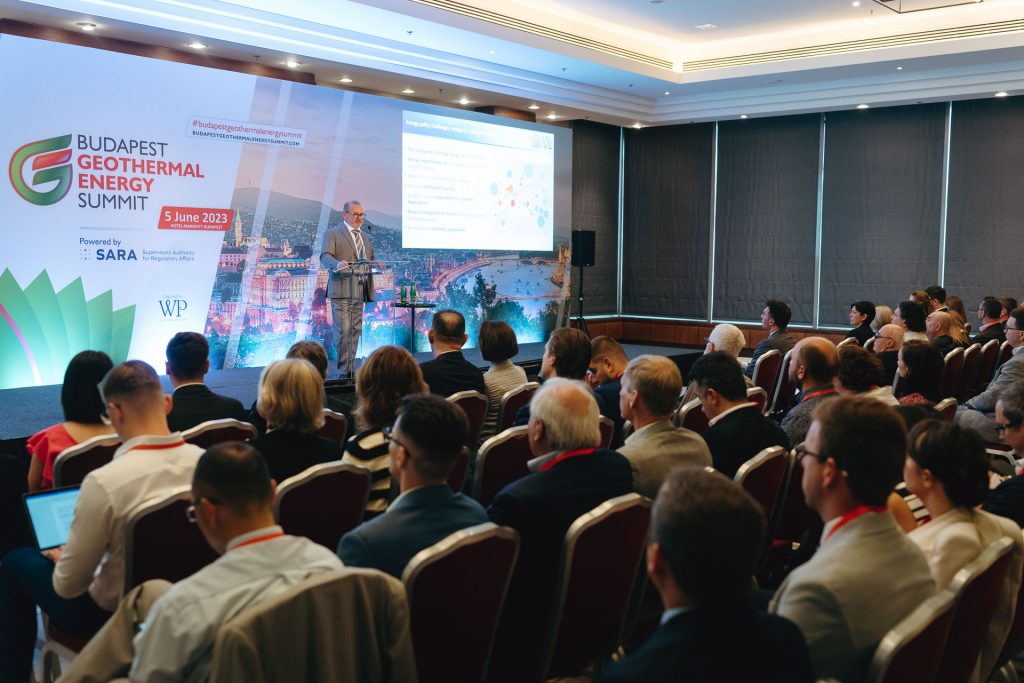
During last year’s Budapest Geothermal Summit, local officials reiterated their belief that Hungary can be a “regional geothermal superpower.” This sentiment was echoed by Miklos Antics, President of the European Geothermal Energy Council (EGEC), describing the country as the “future geothermal energy capital” of Europe. With the national strategy now put to paper, the work starts for the government and various industry players to turn these pronouncements into reality.
Source: Government of Hungary