
Ireland lays groundwork for investable geothermal projects

Ireland’s GEMINI programme is building the data, skills and business models needed to support the country’s first repeatable geothermal projects.
Ireland is using its first geothermal demonstration projects to build the data, skills and commercial frameworks needed for a wider pipeline of investable projects.
Aoife Braiden of the GEMINI project outlined that approach during the workshop day of the European Geothermal District Heating & Cooling Days in Dublin on 4 September 2026. Her presentation focused on how the island of Ireland can move from demonstration projects towards repeatable geothermal investment. We reported on the start of the programme in 2024.
The workshop, organised by the European Geothermal Energy Council (EGEC) and the Geothermal Association of Ireland, centred on finance, risk and project delivery in an emerging geothermal market. Its framing question was how Ireland can move from individual opportunities towards a repeatable heating and cooling market.
For Braiden, the central question is what happens after the current demonstration phase.
“What we’re really trying to get out of today is what’s going to be the next thing,” she said. “What comes after this project?”
Building the foundations for geothermal development
The GEMINI programme was established against a relatively early-stage geothermal market on the island of Ireland.
Braiden said there had been little deep geothermal drilling, limited deep subsurface data, no dedicated geothermal training pathway, few established business models and an incomplete regulatory framework when the project was being developed.
Ireland also lacked a significant base of operating geothermal projects that potential developers, investors or public bodies could visit and learn from.
The EUR 20 million GEMINI project was therefore designed to address several of those barriers simultaneously rather than concentrate the available funding on a single demonstration.
The cross-border programme brings together 15 partners and is supported through the PEACEPLUS programme, with funding from the European Union, the Government of Ireland and the Northern Ireland Executive. The project was formally launched in November 2024 and runs through 2028.
Its scope includes geothermal demonstrations, subsurface data, skills development, planning tools, business models, community engagement and work intended to support future regulation.
Demonstration projects designed for replication
A central principle of GEMINI is that the physical projects should provide more than evidence that geothermal technology works.
The processes used to develop them are also intended to become reusable.
Braiden said procurement experience, geological models, training materials, planning tools and project-development lessons will be made available so that future projects do not have to start from the same point.
“Everything is going to be made available,” she said. “That’s the key bit to getting the next project up and running because otherwise we’re going to start to scratch each time.”
The demonstrations cover different applications and levels of geothermal development.
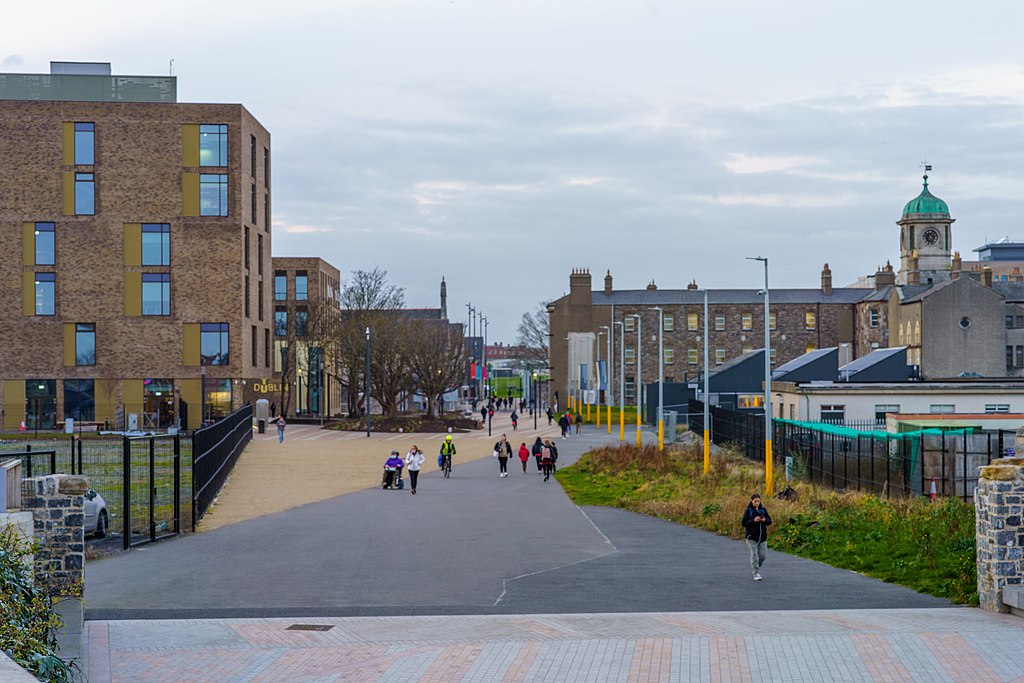
At TU Dublin’s Grangegorman campus, the programme is supporting work towards an approximately 2 km geothermal exploration borehole. The project is intended not only to investigate a potential local heat resource, but also to improve understanding of the wider Dublin Basin.
The work builds on Geological Survey Ireland research presented during the first day of the Dublin event, which identified significant shallow and deeper geothermal potential beneath the capital.
Other GEMINI activities are intended to test geothermal applications that could be more directly replicated elsewhere.
Braiden highlighted a sports-centre project as an example where both the technical system and the procurement process could become a template for similar public facilities.
In Northern Ireland, the programme is also supporting training and demonstration activities intended to build practical installation and maintenance capacity.
Data, skills and planning are part of the project
The programme is also investing in infrastructure that will not be visible at individual demonstration sites.
This includes data platforms, geological models and tools for planners, as well as professional training and education.
Braiden said planners need both better information and guidance on how to use it so that geothermal projects do not become delayed at the decision-making stage.
The programme is therefore developing material for continuous professional development as well as university and technical education.
That reflects another constraint in an emerging market: there is limited value in creating demand for geothermal projects if there are too few people able to design, procure, regulate and operate them.
GEMINI is also examining business models and technical-economic feasibility, including how geothermal might work alongside heat networks and what future financial support could be required.
The objective is to produce evidence that can inform both project developers and policymakers.
The next project will need private-sector participation
The more difficult question is how Ireland moves beyond publicly supported demonstration.
Braiden said the current programme was deliberately designed to build capability, but the next phase will need organisations willing to take geothermal into commercial or institutional applications.
That could include hospitals, large private companies, public bodies or other major heat users.
“Who’s going to be the next champion for this?” she asked.
The challenge is particularly relevant because Ireland does not yet have an established geothermal development market where new projects can simply follow existing commercial precedents.
Risk-sharing mechanisms and targeted incentives are therefore likely to remain important during the next phase, according to Braiden.
The broader objective is to create enough confidence that geothermal projects can eventually progress without having to reconstruct the entire technical, commercial and regulatory framework for every site.
Geothermal could also reduce pressure on the grid
Braiden also highlighted an aspect of geothermal heating that is becoming increasingly relevant in Ireland: its potential contribution to reducing electricity-system demand.
Much of Ireland’s decarbonisation strategy depends on electrification alongside growth in renewable electricity.
But grid capacity itself is becoming a constraint in some areas.
Geothermal systems coupled with heat pumps still require electricity, but can deliver significantly more thermal energy than would be produced through direct electric heating.
For large heat users, that could become part of the investment case.
Braiden pointed in particular to data centres and cooling demand as areas where greater attention should be given to subsurface thermal resources.
This also connects with wider discussions during the Dublin event around geothermal heating, cooling, thermal storage and the value of reducing demand on electricity networks.
From demonstration to an investable market
The GEMINI programme is now roughly halfway through its planned duration, with several of its major outputs still to be delivered.
The immediate task is to complete the demonstration, data and capacity-building work.
The longer-term test will be whether those outputs make subsequent geothermal projects easier to develop.
That means reducing uncertainty, improving access to information, creating experienced supply chains and giving developers, heat users and investors greater confidence in how projects can be structured.
For Ireland, the significance of GEMINI may therefore depend less on the number of demonstration sites delivered under the programme than on whether those projects create a credible pathway for the ones that follow.
The ambition is to move geothermal from an unfamiliar option towards a repeatable investment proposition.