
Making geothermal investible in Ireland – An interview with Rory Dunphy


#image_title
Ireland is not traditionally known for geothermal, but the region holds huge potential for shallow and deep geothermal for heating and cooling.
Ireland is not a country typically associated with geothermal energy. It has no active volcanism, no established deep geothermal industry, and has a relatively small market for geothermal heating and cooling. Yet, there is an opportunity for Ireland to become a model for deploying geothermal in a region that is not traditionally considered a fit for geothermal.
The country has one of Europe’s most fossil-fuel-dependent heating sectors, growing pressure on its electricity grid, ambitious decarbonization targets, and a developing district heating market. At the same time, shallow geothermal resources are available across almost the entire country, while ongoing research is improving understanding of deeper resources.
For Rory Dunphy, Chairperson of the Geothermal Association of Ireland (GAI), the opportunity is therefore less about proving that geothermal can work and more about creating the conditions for it to scale.
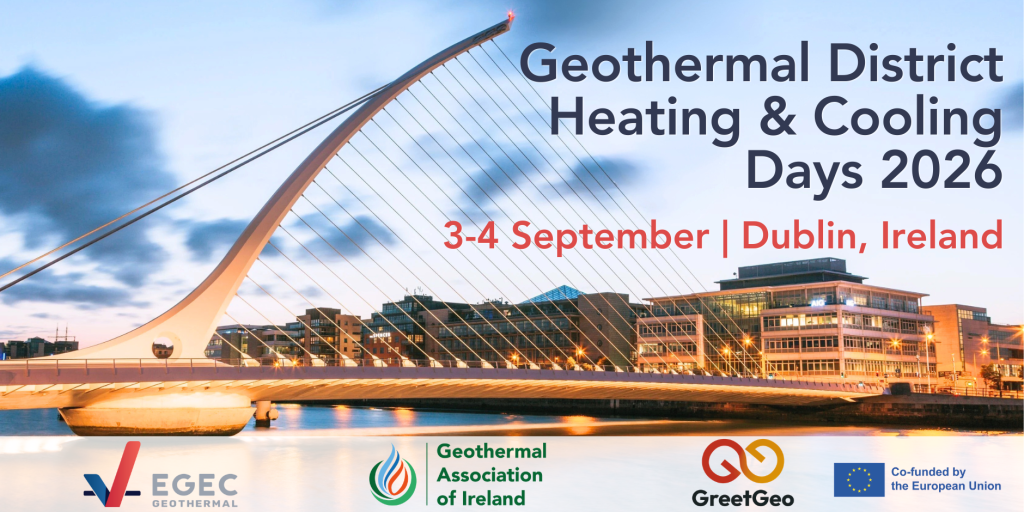
That challenge will be a central theme when the European geothermal community gathers in Dublin for the Geothermal District Heating and Cooling Days 2026, taking place on 3–4 September and organized by the European Geothermal Energy Council (EGEC) in collaboration with GAI. The event will bring together heat users, developers, policymakers and financiers to discuss how geothermal heating and cooling markets can move from potential to investible projects.

Renewable heating as a massive gap in Ireland
Ireland has made considerable progress in renewable electricity, particularly through wind power, but heat remains a much more difficult part of the energy transition. In 2024, more than 90% of Ireland’s heat demand was still met by fossil fuels, while renewables accounted for only 7.9% of heat consumption, ranking it among the lowest shares in the European Union. Heat-related greenhouse gas emissions account for approximately 40% of the country’s total energy-related emissions.
“In a word, I’d describe the opportunity as massive,” said Dunphy.
Ireland’s dependence on imported fossil fuels for heating makes the issue not only one of emissions, but also of energy security and exposure to international energy prices. According to Dunphy, this creates a particularly compelling case for geothermal in public buildings, hospitals, universities, commercial campuses, housing developments, leisure centres, data centres, and the pharmaceutical and agri-food sectors.
The opportunity is particularly strong for shallow geothermal and ground-source heat pumps (GSHPs). The Sustainable Energy Authority of Ireland (SEAI) estimates that 94% of the country is either suitable or highly suitable for shallow geothermal resources, which can be used as a stable thermal source for heat pumps. Ireland also has recognized potential for deeper low- to medium-temperature geothermal resources suitable for larger heating and cooling applications.
Cooling could add another dimension to this market. Dunphy noted that increasingly well-insulated Irish homes can become uncomfortably warm even during relatively moderate summer temperatures. Shared ground-loop systems for new housing developments could therefore provide both heating and efficient cooling from the same subsurface infrastructure.
More broadly, Dunphy argues that geothermal needs to be viewed as energy infrastructure rather than simply another heating technology. A properly designed ground-source system can provide heating, cooling and underground thermal storage over a long operating life. This distinction becomes important as Ireland electrifies more of its economy. A geothermal heat pump system can reduce the amount of electricity required to produce a given quantity of useful heat compared with less efficient configurations, potentially reducing peak demand and connection requirements. For a country already facing grid constraints, the value of geothermal therefore extends beyond the individual building or heat user.
“The current geothermal market is small in Ireland,” Dunphy remarked, but the combination of a major decarbonization problem, political commitment, and the country’s capacity to invest provides the environment for the growth of this market.
Ongoing efforts for geothermal in Ireland
Current efforts are already establishing the foundation of an emerging geothermal sector. The GAI estimates that Ireland has more than 200 MWth of installed geothermal capacity across over 20,000 systems. Most of the these installations are small, so Dunphy sees the next step as moving toward larger commercial, industrial, institutional and communal residential applications.
Some recent projects are beginning to demonstrate project at a larger scale. Trinity College Dublin has installed a ground-source heat pump system to decarbonize heating in a historic building dating from 1699, demonstrating how geothermal can be integrated with minimal visual and noise impact. Geoserv Solutions, meanwhile, is preparing to begin construction of a multi-million-euro geothermal heating and cooling system for a new Health Service Executive hospital emergency department.
According to Dunphy, projects such as these are helping to “demystify geothermal” within the public sector, with a corresponding increase in geothermal-related tenders.
Government policy has also started to catch up. Ireland published its Policy Statement on Geothermal Energy for a Circular Economy in 2023, setting out an intended regulatory approach for shallow and deep geothermal and the scope of a wider national strategy. The policy envisages licensing for exploration and utilization of deep geothermal resources, alongside measures covering data, financial incentives, skills, planning, public engagement and deployment in publicly funded buildings.
For the industry, however, moving from policy intent to implementation is now critical. Dunphy argues that the promised framework needs to provide certainty over resource ownership while also considering support and risk-mitigation mechanisms similar to those used in more mature European geothermal markets.



A key test will be the GEMINI project, which will implement geothermal demonstration activities at several sites and is intended to address barriers that have held back deployment in Ireland. At TU Dublin’s Grangegorman campus, plans include drilling a deep geothermal borehole to investigate whether geothermal energy can contribute to decarbonizing the campus district heating system.
Shallow geothermal could play an equally important role in emerging heat networks. Arrays of boreholes coupled with heat pumps can provide heating, cooling and seasonal thermal storage, making them particularly relevant for mixed-use developments and campuses with different heating and cooling profiles.
Dunphy points to a recent geothermal feasibility study by Dublin Airport Authority as evidence of growing interest. He also highlights the possibility of adding underground thermal storage to systems such as the Tallaght District Heating Network, where heat from an Amazon data centre is already being recovered. Storing excess summer heat underground could allow waste heat to be retained until it is needed later in the year.
The long-term value proposition of geothermal
If geothermal has these advantages, why has deployment remained limited? For shallow geothermal, Dunphy identifies inadequate early-stage assessment and procurement models that do not always suit integrated geothermal projects. There is also a tendency to judge technologies primarily on upfront capital expenditure.
Ireland’s aggressive 2030 decarbonization targets can inadvertently reinforce this problem. Air-source heat pumps can appear faster and cheaper to install for large heating projects, while the potential benefits of geothermal over the full life of a project, including heating, cooling, storage and lower electricity requirements, may not be fully captured in investment decisions. The problem is not necessarily that geothermal cannot deliver an attractive long-term proposition, but that project structures do not recognize its long-term value when considering the higher upfront investment.
A workshop at the Dublin event, “Making Geothermal Investible in Ireland,” seeks to discuss these policy and technology gap, among several other pressing issues.
Ireland already provides some funding support, such as the Support Scheme for Renewable Heat which offers eligible non-domestic users grants covering up to 40% of investment in air-, ground- and water-source heat pumps. However, Dunphy also sees considerable potential in financing structures such as a “heat-as-a-Service” model, where the customer purchases useful heating and cooling rather than bearing the full cost and technical risk of owning the geothermal infrastructure. Such models could shift the decision away from comparing equipment purchase prices and toward comparing the long-term cost and performance of providing thermal energy.
For deep geothermal, the investment challenge is different. The resource must first be confirmed, and drilling means that significant capital can be exposed before commercial performance is known. Dunphy therefore argues for greater public investment in geological data, followed by mechanisms that allow the public and private sectors to share exploration risk.
More than half of Ireland’s heat demand is concentrated in its five largest urban centres – Dublin, Cork, Galway, Limerick and Waterford. GAI is calling for a strategic, multi-year programme of seismic acquisition and drilling focused initially on areas where geothermal potential overlaps with concentrated heat demand.
Such an exploration campaign could build on the lessons from GEMINI to identify specific prospects that could subsequently attract commercial investment. Financial mechanisms already familiar elsewhere in Europe – including European Investment Bank financing, green bonds and geothermal risk-mitigation or insurance facilities – could then become relevant.
Aside from finance and regulation, Dunphy also considers a lack of awareness as a more fundamental constraint. Rather than asking only what policy instrument or subsidy Ireland needs, Dunphy suggests asking who will move first: who in government will champion geothermal, which housing developer will recognize the long-term value of shared ground loops, and which public-sector engineer will insist that geothermal is properly evaluated alongside more conventional solutions?
Dunphy looks into other European markets for useful examples. In the Netherlands, for instance, horticulture provided an early commercial market for deep geothermal development. Ireland may need to find its own equivalent group of early adopters.
This is also where the Geothermal District Heating and Cooling Days in Dublin can have an impact. The event is designed to bring together three groups that do not always meet early enough in project development: the organizations that need heat, the companies capable of delivering geothermal solutions, and the policymakers and financiers that can enable investment.
What to look forward to for Ireland’s geothermal sector
The next five years could determine whether the activity now taking place develops into a self-sustaining industry. Ireland’s renewable heat share remains low, but that also means the need for new solutions is substantial. Under current EU requirements, Ireland needs to raise the renewable share of heating to around 15.8% by 2030. At the same time, government policy is promoting district heating, while geothermal-specific policy, data gathering and demonstration projects are beginning to create a foundation for deployment.
For Dunphy, meaningful progress by 2031 would mean geothermal legislation is fully operational, national targets exist for geothermal heating and cooling, and financing mechanisms address both the upfront cost of efficient GSHP systems and the exploration risk associated with deep geothermal. More importantly, geothermal screening could become a routine part of decision-making for public-sector retrofits, new buildings and district heating projects.
The private market could develop in parallel. Dunphy expects shared-loop geothermal systems to become increasingly relevant for residential developments, while campuses and heat networks could adopt Heat-as-a-Service models that transfer the technical and financial complexity of geothermal infrastructure away from individual heat users.
There is even an opportunity to develop an exportable Irish geothermal services sector. With a sufficiently strong domestic project pipeline, Dunphy hopes Irish consultants, drillers, designers and developers can build expertise that allows them to compete internationally.
However, the more significant change that Dunphy aspires for is one of perception. For decades, geothermal development has been associated primarily with countries possessing obvious high-temperature resources. Ireland represents a different proposition: a country without a traditional geothermal industry attempting to use shallow resources, heat pumps, thermal storage, heat networks and potentially deeper resources as part of an integrated approach to decarbonizing heat.
Rather than asking whether geothermal works in Ireland, Dunphy wants heat users, utilities and public bodies to be discussing where geothermal makes sense, how projects should be procured and which business models deliver the greatest long-term value.
That makes Dublin a fitting venue for this year’s Geothermal District Heating and Cooling Days. Previous editions have been held in established European geothermal and district heating markets including Berlin, Aarhus, Paris and Vienna. The 2026 edition brings the conversation to a country at a much earlier stage of market development, but one where the need for renewable heating, thus the opportunity, is substantial.
Ireland may not yet be a major geothermal market. What happens next will depend on whether the country can turn policy, geological knowledge, and demonstration projects into projects that heat users can procure and investors can finance.
For Dunphy, Ireland could ultimately provide a useful model for other emerging geothermal markets. “I firmly believe Ireland can become a model in Europe for how to build and scale a geothermal market in a jurisdiction with little history in the sector,” he said.