
Next-gen geothermal opportunities in Taiwan highlighted in TIGC 2026

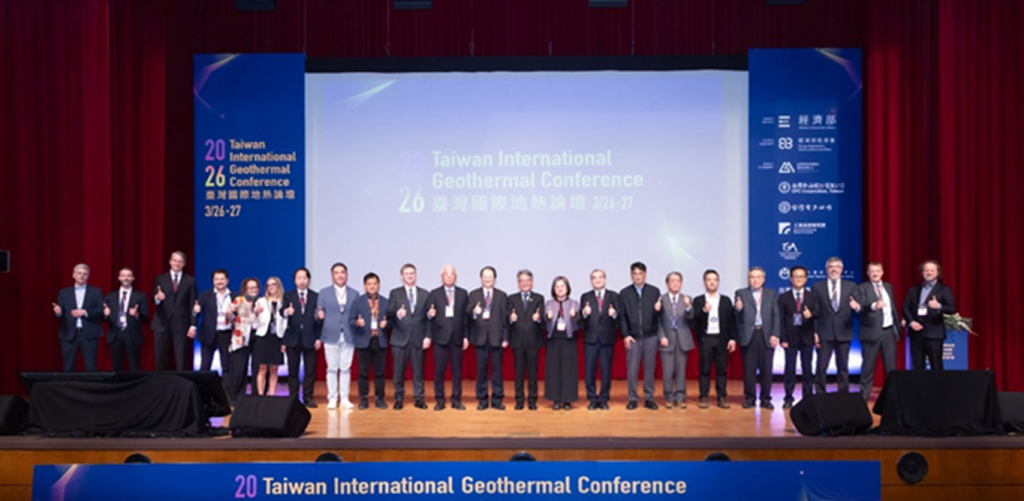
The 2026 edition of the Taiwan International Geothermal Conference highlighted opportunities and challenges for next-generation geothermal development.
The 4th Taiwan International Geothermal Conference (TIGC 2026), hosted by the Ministry of Economic Affairs (MOEA), was recently held in Taipei. The event attracted over 700 local and international participants to discuss the state of geothermal development in Taiwan, with a special focus on the opportunities for next-generation geothermal technologies.
As Vice Minister Lai Chien-hsin stated in his opening remarks, the Government of Taiwan has grasped the current international situation related to the stability of energy supply, and has responded appropriately. The power development plan of the Taiwan Power Company (Taipower) ensures that supply will exceed future demand while continuously strengthening power stability and resilience towards the vision of a carbon-reducing nation. Moreover, the second energy transition plan promotes various renewable energy policies aiming to attain Taiwan’s net-zero carbon emissions target by 2050.
Updates on ongoing projects and initiatives
Chen Qianyu, section chief of the Oil and Gas Development Division of the Energy Administration, stated that Taiwan has set a target of developing 6 GW of geothermal power generation capacity by 2050. To achieve this, the government is actively creating an environment that will attract more investment in the sector. Measures include the simplification of application and permitting procedures, as well as the introduction of a special feed-in tariff for next-generation geothermal power projects.
The official further stated that a tender for geothermal sites on public land in Taitung is expected to be announced by April.
Chen Bingcheng, director of the Geothermal Department of CPC Corporation Taiwan, shared that CPC has already built geothermal power plants in Tuchang and Renze, both in Yilan County. Moreover, a research well has been drilled to 4000 meters depth in Yuanshan, while a second well is being drilled in Dongshan, also targeting a depth of 4000 meters.
If the drilling operations of CPC are successful, the plan is to introduce new technologies such as EGS and AGS in Datunshan by the second half of the year.
Hsu Wen-ke, director of the Renewable Energy Department of Taipower, also said that the plan is to expand the capacity of the Renze geothermal power project from the current 0.84 MW to 3 MW. To do this, the company will be offering investment opportunities for the project in the second half of the year. There are also other sites being developed, such as in Guguan in Taichung, and in the Datun Mountain.
Experience from international players
As Taiwan explores the possibility of deploying next-generation geothermal technologies, a number of international players present at the TIGC presented pathways towards realizing this ambition.
A representative from Halliburton explained that EGS can help create new fractures in systems hosted by hot dry rock. However, he also cautioned that the highly fractured geology of Taiwan and its location in a seismic zone means that extreme caution must be exercised to avoid creating induced seismicity. Baker Hughes presented how a modular approach to geothermal power installation can help Taiwan increase power generation density quickly, with the recommendation of implementing EGS and AGS systems where appropriate.
Lastly, Iceland Drilling shared its experience in drilling in high-temperature geothermal systems, stating that it is willing to support Taiwan in drilling into supercritical geothermal resources.
Source: MOEA and Environmental Information Center