
Quaise provides funding support to OSU research to simulate superhot rock geothermal conditions

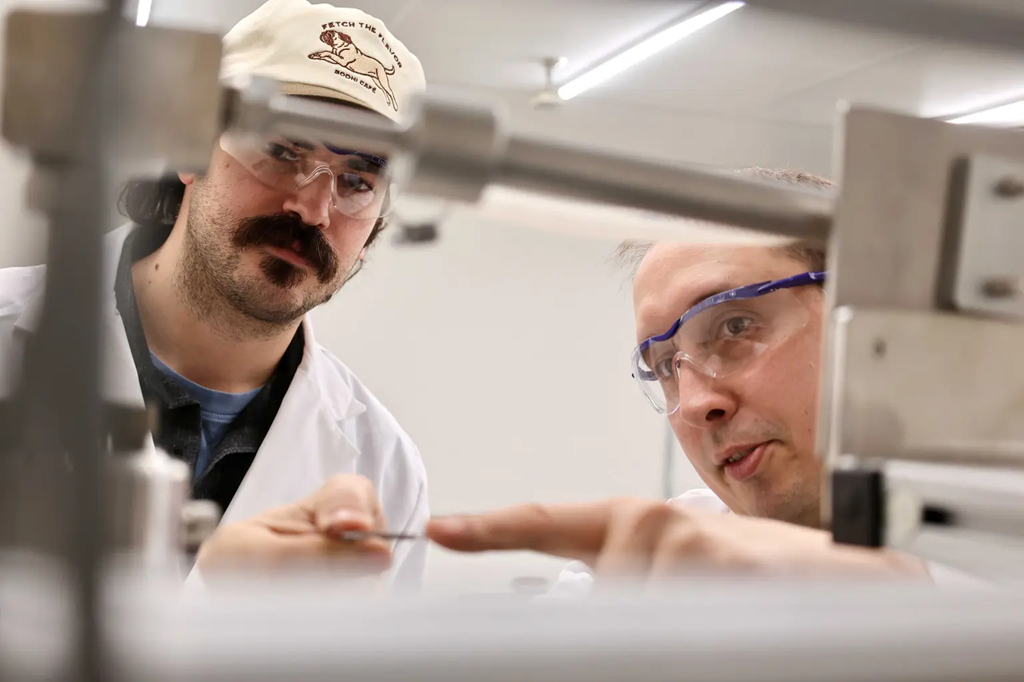
Quaise Energy has provided funding support to Oregon State University for research on processes and material behavior under superhot rock geothermal conditions.
Innovative geothermal company Quaise Energy has given $750,000 to Oregon State University (OSU) for a project that aims to recreate superhot rock (SHR) geothermal conditions in the laboratory. This will allow for detailed studies on fluid behavior, scaling, and fluid-rock interactions under SHR conditions, which could help reduce the technical and final risk of developing SHR geothermal power projects.
“We’re developing a flow-through reactor that allows us to move fluid through the same kinds of rock under superhot conditions while letting us look at how the systems change in real time,” says OSU Assistant Professor and Barrow Family Chair in Mineral Resource Geology Brian Tattitch. He leads the Experimental Deep Geothermal Energy (EDGE) lab in OSU’s College of Earth, Ocean, and Atmospheric Sciences.
The custom-made OSU reactor is designed to withstand temperatures of up to 500 °C and 500 atm of pressure. Water pumped through small permeable cracks in rocks under such conditions would become supercritical, which has about five times more energy density than hot water. This would translate to a higher efficiency and output when the thermal water is used to generate power.
The research that will be done at EDGE will complement the millimeter wave drilling technology being developed by Quaise, as it aims to access SHR geothermal conditions at depths of 2 to 12 miles. As Quaise CEO says, getting to these depths is “beyond the economic reach of the conventional tool set of oil and gas.”
Researching different scenarios of superhot rock geothermal conditions
Research at the EDGE will have three general avenues:
- Research on how rock behaves under SHR conditions. This will answer questions such as whether there will be mineral deposition within fracture systems as thermal fluids flow through them.
- How the vitrified glass liner, a byproduct of Quaise’s drilling technology, behaves under SHR conditions. This is important in validating the integrity of the wellbore that is drilled using millimeter wave.
- Research on how other materials, such as sand, react under SHR conditions.
Tattich and his team are excited about the SHR research, as well as involving undergraduate and graduate students with the work. “Right now, SHR is a frontier. Those students will go on to have careers in the field when it becomes a functional method for generating significant power,” said Tattich.
Source: Quaise Energy