
RBC sees Fervo IPO reshaping geothermal finance

#image_title
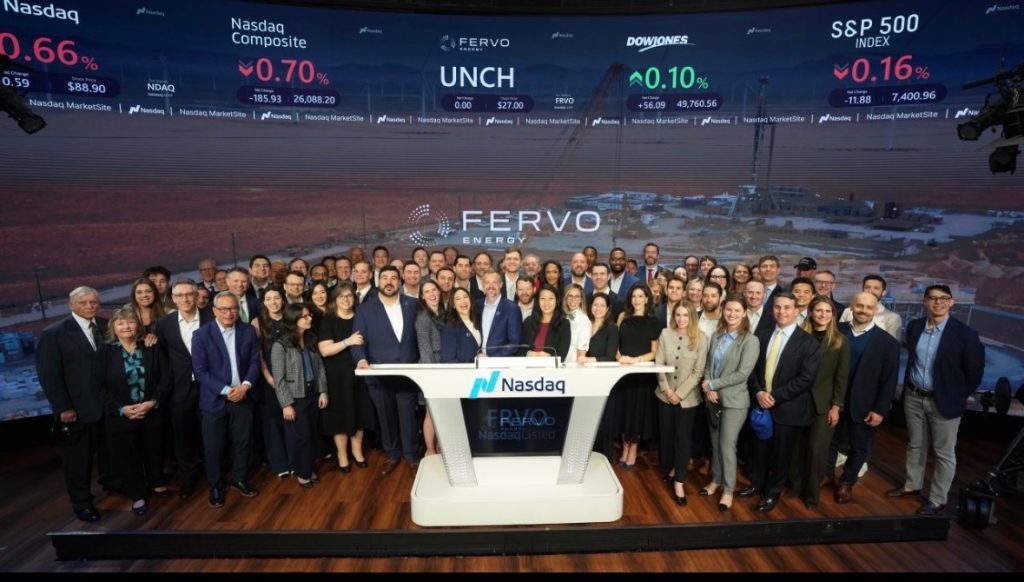
RBC Capital Markets discusses the significance of Fervo Energy’s IPO and what it could mean for geothermal investment and future listings.
The successful IPO of Fervo Energy has quickly become one of the defining financial stories for the geothermal sector in 2026.
Priced above its revised range, the IPO raised roughly USD 1.9 billion, with the over-allotment option bringing the total transaction size to approximately USD 2.2 billion. This transaction marked not only a major milestone for Fervo Energy, but also a potentially significant moment for geothermal energy in public capital markets.
In an interview with ThinkGeoEnergy, Jonathan Sisto, Managing Director, AI Energy Solutions & Energy Transition at RBC Capital Markets, which acted as Joint Lead Bookrunner on the IPO, shared insights into investor sentiment, geothermal’s positioning within the broader energy transition, and what the transaction could mean for future geothermal developers seeking access to public markets.
“A viable public market exit path”
According to Sisto, the IPO represents more than just a single company success story.
“Fervo Energy’s IPO is not only an important milestone for the geothermal sector but also the whole energy transition space, for industrial decarbonization, for entrepreneurs, and for early-stage investors,” Sisto told ThinkGeoEnergy.
“It proves that there is a viable public market exit path.”
The IPO also attracted attention because investors appeared willing to assign Fervo Energy a valuation premium relative to established geothermal players such as Ormat Technologies.
Sisto noted that investors focused heavily on Fervo’s projected growth trajectory, including plans outlined during the IPO process targeting 1 GW by 2030 and 5 GW by 2035, as well as the company’s large acreage position and framework agreement with Google.
“The company’s approximately 600,000-acre footprint was front and center,” Sisto explained. “This signaled to investors that, similar to Oil & Gas shale development, the company could eventually move toward a manufacturing-style deployment model.”
Geothermal increasingly viewed as “firm clean power”
The IPO process also highlighted how some investors are increasingly viewing geothermal within the broader category of ‘firm clean power’ technologies.
Rather than being compared solely to traditional renewable energy technologies, geothermal was increasingly discussed alongside other “firm clean power” technologies.
“In the case of Fervo, public companies in the nuclear space like Oklo, NuScale, and X-Energy were part of the conversation,” Sisto said.
“If I can speak broadly for investors, there was an element that Fervo and geothermal power can be additive to the grid today versus further out in time, and by using proven technologies from the Oil & Gas sector.”
Sisto emphasized that signed PPAs, construction progress, and project execution were all critical in building investor confidence during the IPO process.
“By having these items in hand, portfolio managers analyzing the opportunity saw Fervo as more de-risked than many other opportunities in the energy transition ecosystem.”
The ability to deliver electricity at scale was also viewed as important.
“Geothermal can grow from roughly 0.3% of U.S. utility-scale electricity generation today to multiple gigawatts,” Sisto noted.
Could more geothermal IPOs follow?
Sisto believes the transaction has already changed how public markets view geothermal.
“Fervo’s IPO has undoubtedly brought more investor eyeballs to the sector,” he stated.
At the same time, he cautioned that public listings require significant preparation and operational credibility.
“An IPO process takes time and a lot of behind-the-scenes work with auditors, lawyers, bankers, and reserve engineers,” Sisto said.
“The time is now and companies and their current investors should be acting with urgency to drill wells, get pilots running, and court off-takers.”
For other geothermal developers, Sisto stressed that operational execution remains the key differentiator.
“People will tell you ‘No’. Stay at it,” he said, referring to Fervo’s nine-year journey since founding.
“But in the end, operational results are what truly resonate with investors.”
Looking ahead, Sisto expects the public geothermal landscape to continue expanding.
“I think in a period even less than five to ten years, the market is likely to see more public geothermal companies beyond Fervo and Ormat, and greater involvement from public Oil & Gas companies in the geothermal space,” Sisto told ThinkGeoEnergy.
“It is an exciting time.”
The interview comes ahead of the World Geothermal Congress in Calgary, where geothermal financing, commercialization pathways, and the growing intersection between geothermal and energy markets are expected to be key discussion themes. ThinkGeoEnergy will also host a by-invitation breakfast discussion with Rystad Energy during WGC Calgary focused on geothermal investment trends and market development.