
Study finds geothermal learning remains highly local

New research finds global geothermal costs rose with deployment, while learning and cost reductions remain strongly shaped by local conditions.
A new study of geothermal power development over seven decades finds that costs have risen rather than fallen with increasing global deployment, while the ability to reduce costs differs substantially between individual markets.
Published in iScience, the research by Florian Mueller, Bjarne Steffen and Tobias S. Schmidt examines the experience rates of geothermal power technologies globally and at country level. The authors conclude that much of the knowledge required to develop geothermal projects remains local or regional, limiting how easily experience can be transferred between projects and markets.
The researchers compiled data on all 514 geothermal power plants commissioned over roughly seven decades, including installed-cost data for 206 plants. They combined the quantitative analysis with 51 expert interviews to examine the factors behind different cost trajectories.
Global geothermal costs have not followed solar-style learning
The study estimates a global geothermal experience rate of -20%. In the terminology used for experience curves, this means that installed costs increased by about 20% for every doubling of cumulative installed geothermal power capacity.
“It is a central estimate out of a larger confidence interval, so the precise value should not be over-read,” Mueller told ThinkGeoEnergy.
The researchers nevertheless say they can state with 97% confidence that global geothermal costs have risen rather than fallen as installed capacity increased.
This trajectory differs from technologies such as solar PV and batteries, where greater deployment has historically been associated with substantial global cost reductions.
For geothermal, learning through deployment can be offset by other factors. Development can move towards more difficult resources, projects can face greater design and regulatory requirements, and expertise can be lost when project pipelines are interrupted.
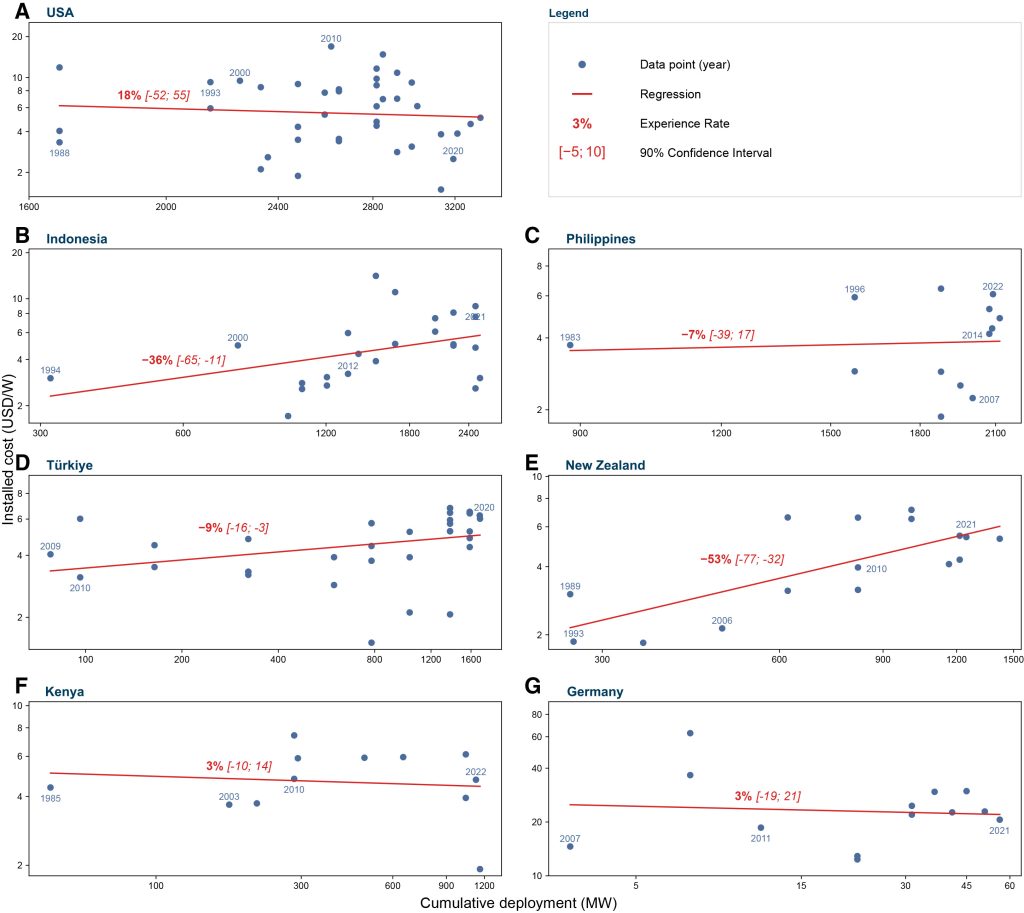
The country-level results also vary considerably. Point estimates range from an experience rate of +18% in the United States, indicating declining costs with deployment, to -53% in New Zealand, indicating rising costs.
The differences are central to the authors’ argument that one global learning curve cannot fully describe how geothermal development evolves across different markets.
Much of geothermal knowledge remains local
For Mueller, this geographical variation is one of the study’s core findings.
“Most of the knowledge needed for a successful project sits at the local to regional level,” he said.
Hydrogeology is one reason. Experience gained from one reservoir may have limited application even a relatively short distance away if geological conditions change.
Regulation can have a similar effect. Relationships between developers, regulators and local stakeholders are built within individual markets and can be lost if deployment stops for a prolonged period.
This differs from technologies based more heavily on standardised manufacturing. Knowledge developed in the solar PV industry, for example, can move with companies, engineers, manufacturing equipment and supply chains between countries.
Geothermal projects remain much more closely connected to the physical resource and the local environment in which they are developed.
The study identifies six factors affecting geothermal learning, including resource productivity, project design complexity, hydrogeological variation, tacit drilling knowledge, regulatory conditions and knowledge transfer from industries such as oil and gas.
What makes a geothermal market learn faster?
The interviews point to several characteristics that can help experience accumulate more effectively.
Relatively homogeneous geology allows knowledge from one reservoir to carry over to subsequent projects. Stable regulation reduces the need to repeatedly adapt development processes, while a continuous pipeline of projects helps retain drilling teams, suppliers and other specialist expertise.
Existing oil and gas capability can provide equipment and experienced drilling crews. Mueller also points to regulatory knowledge as an important spillover. Markets with an established drilling industry often have regulators who already understand the questions they need to ask.
Continuity is particularly important because much of geothermal drilling expertise is tacit and remains with individuals and teams.
For governments, Mueller argues that this favours predictable, long-term deployment rather than isolated flagship projects. Public support for exploration data, early-stage risk cover and regulatory capability can also help create markets in which experience is retained between developments.
Public acceptance forms another part of that local capability and, as Mueller notes, has to be earned project by project.
Will EGS and closed-loop geothermal learn differently?
The paper also considers whether enhanced geothermal systems (EGS) and closed-loop geothermal could follow fundamentally different learning trajectories.
The researchers do not calculate empirical experience rates for these technologies because commercial deployment remains too limited. Instead, they assess two characteristics associated with technological learning: project design complexity and the degree of customisation required.
On both measures, EGS and closed-loop systems retain many of the characteristics that the authors associate with slower global learning in conventional geothermal development.
This does not mean that individual parts of the development process cannot improve quickly.
ThinkGeoEnergy has reported substantial improvements in drilling performance at Fervo Energy’s Cape Station EGS project in Utah. In July 2026, the company reported drilling its 5,927-metre Sawtooth 7 well in 21 days, while maintaining a 70% reduction in drilling time compared with its earlier Project Red baseline.
Mueller said such improvements do not necessarily contradict the paper’s broader conclusion.
EGS could significantly expand the amount of geothermal resource that can be developed within a region. If that creates a sufficiently large and continuous project pipeline, experience could accumulate and costs could fall within that market.
The distinction is between learning in individual technologies and project components, such as drilling, and the ability to transfer an entire geothermal project model between regions with different geology, regulation and local conditions.
Cost curves capture only part of geothermal learning
Installed cost also captures only part of the progress that can occur as a geothermal market matures.
Lower project failure rates, accumulated operating knowledge, improved access to risk insurance, stronger regulatory competence and greater public acceptance can all represent forms of learning that may not be visible in an installed-cost experience curve.
Mueller points to the Greater Munich area in Germany as an example.
The reservoir is now relatively well characterised and several developments can proceed in parallel. Municipalities and private companies, including aero-engine manufacturer MTU, are pursuing their own geothermal projects, while more experienced developers are taking on larger developments.
Insurers have also become more comfortable with geothermal risk, providing guarantees on more favourable terms, while some experienced market participants can proceed without insurance.
This accumulated capability goes beyond individual project costs.
The value of geothermal electricity also extends beyond installed capital cost. Geothermal plants can provide firm and controllable generation, meaning that their role in an energy system cannot be assessed through a simple capital-cost comparison alone.
The findings therefore do not suggest that geothermal development cannot become more efficient. Rather, they indicate that the conditions needed for learning differ from those of highly standardised technologies.
For the authors, future cost reductions may depend less on global deployment alone and more on creating repeatable regional markets where geology is understood, projects continue to be developed and specialist knowledge can be retained.
In addition we recommend also to look at some of the findings in the IEA report on the “Future of Geothermal” published in 2024
Source: Florian Mueller, Bjarne Steffen and Tobias S. Schmidt, “Experience rates of current and future geothermal power technologies,” iScience (2026)
Picture: Country-level costs and experience curves of geothermal power (A-G) Country-level experience rates. Costs are in 2024 USD per W; deployment is given in MW. Vertical axis: Plant costs in 2024 USD per W. Horizontal axis: National deployment in MW. (Figures 3A-G from the report).