How Geothermal Heat Pumps Work
Geothermal heat pumps operate on the principle of transferring heat between a building and the ground, which remains at a relatively constant temperature below the surface. The core system includes an evaporator, compressor, condenser, and expansion valve. In heating mode, the system draws heat from the ground, compresses it to a usable temperature, and delivers it indoors. In cooling mode, the cycle reverses, rejecting heat from the building into the ground.
Typical Coefficients of Performance (COPs) range from 3.0 to 5.0, meaning every unit of electricity can produce three to five units of thermal energy. GHPs outperform air-to-water heat pumps in colder climates due to the stable ground temperature. When compared to large heat pumps using seawater, river water, or outdoor air, GHPs often require less maintenance, offer greater year-round efficiency, and avoid exposure to surface freezing or seasonal swings.
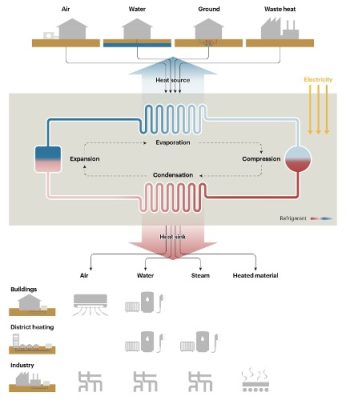 Source: IEA “The Future of Heat Pumps”
Applications and Benefits
Residential and Commercial Buildings
Geothermal heat pumps are widely used in homes, schools, and office buildings. Horizontal loop systems are cost-effective when land is available, while vertical boreholes are ideal for space-constrained urban areas. However, drilling in dense urban environments can be expensive and logistically complex, requiring specialized rigs and permitting coordination. Dandelion Energy (USA), a Google X spin-out, has built a turnkey business model that handles site evaluation, drilling, installation, and financing for suburban homes. This holistic approach reduces customer confusion and increases adoption. In contrast, Celsius Energy (France) has pioneered tripod borehole designs for commercial retrofits in cities like Paris. These vertical systems minimize surface footprint while delivering consistent heating and cooling. With Bedrock Energy, another startup is focusing on efficient groundsource heat pump development with “geo loop fields”. QHeat (Finland) focuses on deeper closed-loop boreholes (up to 1,500 m) that enable block-scale heating, particularly suited for Nordic housing developments. This illustrates how business models and technologies can be adapted to different geographies and user types. There are several other companies worth mention, including Kensa (UK), GeoEnergie Konzept (Germany), and GTML (Norway).Campus and District Systems
At larger scales, campus-wide and district GHP systems supply energy to multiple buildings through shared borefields and centralized heat pumps. Ball State University (Indiana, USA) operates the largest ground-source campus system in North America, serving dozens of buildings. In Europe, pilot projects in Austria and Sweden combine seasonal thermal storage with geothermal loops. Innargi (Denmark) exemplifies the emerging role of heat pumps in boosting geothermal energy from low-to-medium depths (40-80°C) to temperatures suitable for district heating (90-100°C). Its projects in Aarhus and Warsaw integrate deep wells, large-scale heat pumps, and grid distribution infrastructure to replace fossil-based systems with long-term clean heat solutions. Figure: Illustration of planned Princeton thermal network with geo-exchange application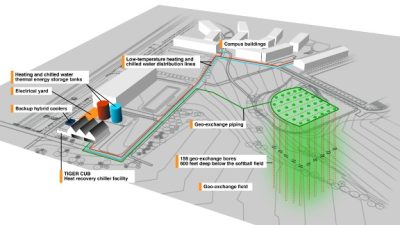 Source: Illustration by Eric Van Nus, Integral Group; Matilda Luk, Office of Communications, Princeton University (2021), “Going Deep – Princeton lays foundation for net zero campus”
Global Market and Growth Outlook
Geothermal heat pumps are installed in over 40 countries, with leading markets in the U.S., Germany, China, Sweden, and Switzerland. The EU Renewable Energy Directive classifies shallow geothermal as renewable, spurring financial support schemes and integration into national heat plans. In China, peri-urban zones increasingly rely on GHPs for residential heating, while U.S. federal incentives under the Inflation Reduction Act are driving uptake in suburban and rural markets.
New models, such as utility-owned loop systems and district-based GHPs, are expanding feasibility in cities. According to IEA and IRENA forecasts, geothermal heat pump deployment could more than triple by 2030 as countries tackle heating-sector emissions. The technology is increasingly seen as a backbone of electrified heat strategies in colder climates.
Challenges and Barriers
Despite strong technical performance, geothermal heat pumps face practical hurdles. High upfront installation costs remain a primary barrier, especially in retrofits. Vertical drilling requires permits and coordination, which can deter adoption. The lack of trained installers and limited public awareness further constrain market growth.
In dense cities, surface area for loops is scarce and drilling logistics are complicated by underground utilities. For developers, coordination between building contractors, HVAC engineers, and drilling firms adds complexity unless a turnkey solution is available – either as a stand-alone delivery model or development under a longer term heat-as-a-service model. Lastly, GHPs are often overshadowed by solar PV in policy visibility, limiting their inclusion in decarbonization roadmaps.
Role in Decarbonizing Heat and Cooling
Heating and cooling account for nearly half of global energy use, much of it from fossil fuels. Geothermal heat pumps offer a scalable, zero-emission alternative, particularly effective in regions with cold winters and increasing electrification. Their consistent efficiency - combined with clean electricity - makes them key assets in national decarbonization plans.
By replacing gas boilers in homes, integrating into district heating, and supporting electrified urban growth, GHPs contribute to both energy security and climate targets. Their long system life and predictable performance also make them attractive to municipalities, utilities, and real estate developers alike.
Figure: Heating & cooling needs by region in the STEPS, 2021 and 2050
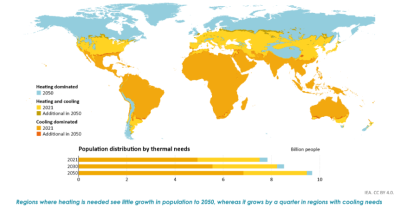 Source: IEA (2022), “The Future of Heat Pumps”, Heating and cooling refer to areas where HDDs calculated with base temperature 18 °C HDD (18 °C) are greater or equal than 1 000 (°C days) and cooling degree days (CDDs) calculated with base temperature 10 °C CDD (10 °C) are greater or equal than 1 000 (°C days).
Differentiating Between Heat Pump Applications
Geothermal heat pumps are often associated with shallow geothermal systems - ground-source heat pumps used for individual homes or small buildings. These systems typically use horizontal or vertical closed-loop configurations installed in the ground at depths up to 100-400 meters, often referred to as 'shallow geothermal.' These are particularly suited for residential use where land is available or for vertical drilling in space-constrained sites.
However, there is growing deployment of heat pumps at larger scale, integrated into systems that tap into geothermal heat from deeper boreholes - ranging from a few hundred meters to up to 1,500 meters. These systems extract naturally occurring subsurface heat at low to medium temperatures and use heat pumps to raise the temperature to the level needed for the specific application.
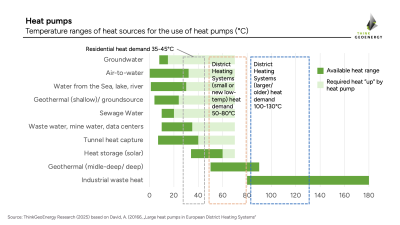
In district heating systems, especially in Europe, this principle is applied to medium-depth geothermal resources in the 40-80°C range. Large-scale heat pumps then boost the temperature to 70-100°C, suitable for feeding both new and existing district heating networks. Older systems often require higher supply temperatures (90-100°C), while newer low-temperature networks can operate at 65-75°C.
Geothermal offers a key advantage here: input temperatures from geothermal wells are significantly higher and more stable than air, seawater, or river water. This results in improved COPs and lower electricity use for the same thermal output. For example, a geothermal-sourced heat pump may achieve a COP of 4.5-5.0, compared to 2.5-3.5 for an air-source equivalent in colder seasons. This higher efficiency translates to lower operational costs and smaller carbon footprints.
There are now several smaller and larger developers offering this model to scale geothermal heating in larger cities in Europe, where geothermal wells are paired with large heat pumps to deliver clean and competitive heating to thousands of residents. This middle-deep approach bridges the gap between shallow geo-exchange systems and high-temperature hydrothermal power production, expanding the role of geothermal in decarbonizing heat at scale.