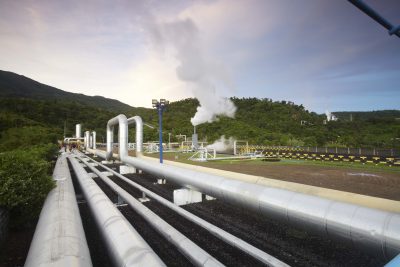
The China Huaneng Group Co. has announced the start of operations of the first geothermal heating plant, located in Zhenzhou in Henan Province, that uses supercritical carbon dioxide as the working fluid.
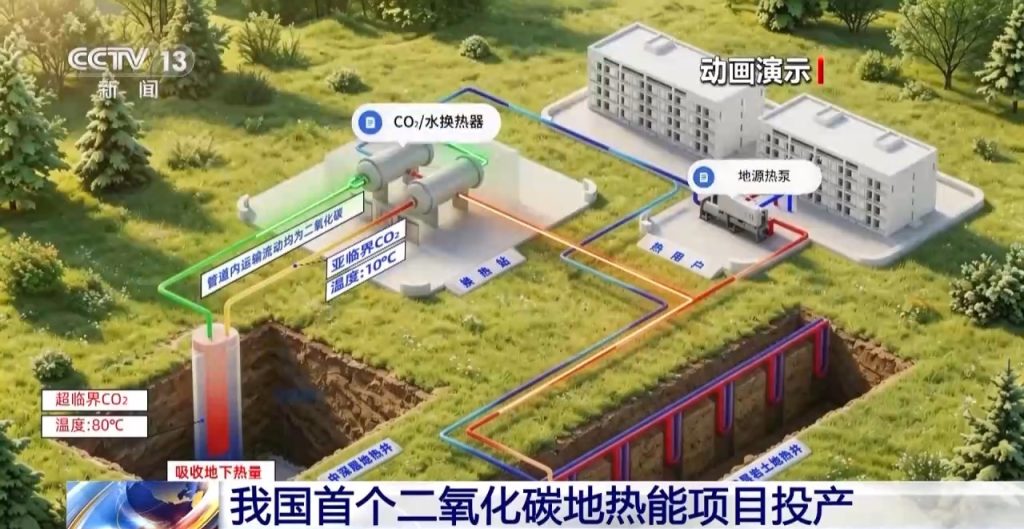
Based on the diagram published by the company, the system utilizes a single borehole system to a depth of 2500 meters. Subcritical CO2 is injected into the borehole at 10 ºC, heated by the formation, and discharged in its supercritical form at 80 ºC. The supercritical CO2 is then fed to a heat exchanger, where it heats up water that is then fed to a heat pump.
According to the company, the higher heat extraction efficiency of supercritical CO2 will increase heat extraction capacity by about 20% and reduce energy consumption by 10%. Since it is designed as a closed system, it does not extract groundwater and create any disturbance in the subsurface geological environment. When the system is fully operational, it will supply the centralized heating needs of over 18,000 m2 of residential housing in the winter.
The concept of using supercritical CO2 as the working fluid in geothermal energy extraction systems has been researched extensively through the years. Examples of such efforts include the CO2 Plume Geothermal concept developed in ETH Zürich in Switzerland, and the basis of the German startup Factor2 Energy.
It is important to note that the existing concepts of using CO2 in geothermal involved injecting it and allowing it to circulate inside the formation. The approach of China Huaneng is fundamentally different as it circulates CO2 inside a closed system. Still, the advantages of CO2 as a working fluid should still be in place – a higher kinematic viscosity allows it to absorb more heat, while a thermosiphon effect reduces the pumping power needed for the fluid to circulate.
Source: Sina and China Huaneng Group