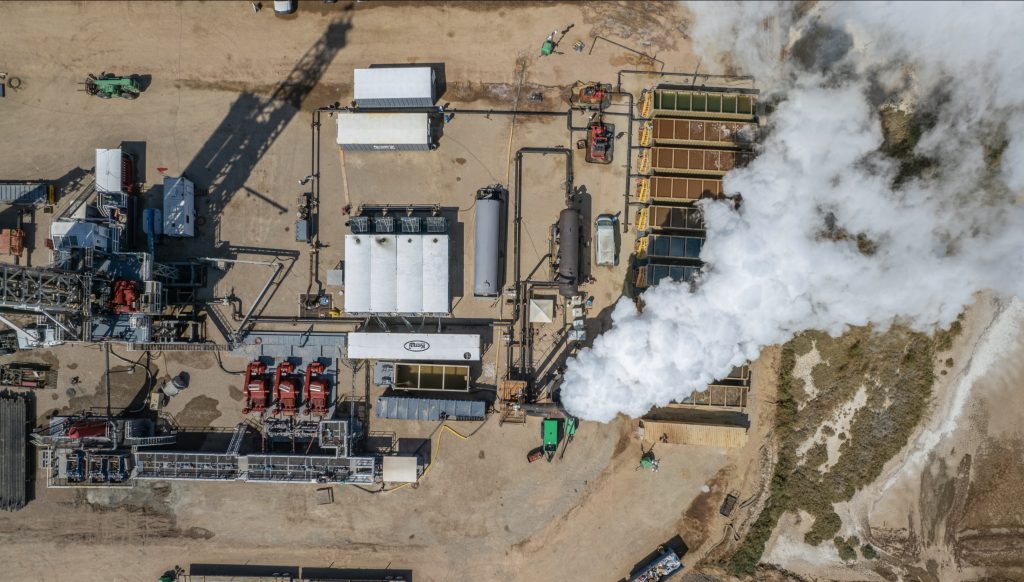
The California Court of Appeals has released a decision declaring that the environmental analysis and review of the Hell’s Kitchen geothermal and lithium project in Imperial County, California did not sufficiently address environmental concerns. This means that the project, being developed by Controlled Thermal Resources (CTR), may possibly need to undergo another round of environmental review.
The California court decision partially overturns a decision made by the Imperial County Superior Court in 2025 which stated that the proposed project did not violate environmental law. This was in response to a lawsuit filed by the environmental group Comite Civico del Valle (CCV), arguing that the approval of the project by the Imperial County Board of Supervisors violated the requirements of the California Environmental Quality Act (CEQA).
Based on the decision issued by the Imperial County Court in 2025, the air quality impacts cited in the lawsuit are based on “a series of ‘if/then’ gates each resulting in a branching path with its own forks. A trail of analysis with numerous ‘if/then’ forks controlled by uncertain, if not random, events (which might or might nor occur in the future) can be done, but will almost certainly lead to endpoints that are speculative.” The decision further states that the non-speculative air quality impacts have been addressed by the project’s environmental impact review.
The three-judge panel of the California Court of Appeals, however, disagreed with this decision on several accounts. According to their decision, the defendants failed to fully consider how the project would affect air quality in the region, or enough water could be available in the county for the project. However, the panel upheld one of the previous findings – that the developer adequately consulted with the regional Native American tribes to identify and mitigate the project’s impacts on cultural resources.
The case has now been remanded to the Imperial County Superior Court, which will have to address the deficiencies outlined in the decision.
CTR envisions a 600-MW pipeline of geothermal power projects at the Hell’s Kitchen site, as well as up to 175,000 tons of lithium products annually. The company has also started steps toward public listing. The Hell’s Kitchen project itself has been identified as a FAST-41 Covered Project, recognizing it as a potentially strategic asset to the United States.
Project delays due to litigation erode investor confidence on the protections provided by regulatory processes, especially when such processes already take up plenty of time and effort. Large-scale projects, like the Hell’s Kitchen project, rely heavily on the predictability of stable legal frameworks. Local governments and regulatory authorities need to work together to ensure that projects, when reviewed and approved based on existing regulations, should be able to proceed with no unanticipated legal challenges.