For an early-stage geothermal sector like that in the UK, creating investor confidence in the market and the quality of resources is a key component for boosting growth. This is the role that multidisciplinary consultancy Arup is playing by providing technical, financial, policy, and strategic expertise to the geothermal industry. Moreover, the firm is also engaged with geothermal projects internationally, thus benefitting from opportunities for cross-region experience and sharing of expertise.
In this interview with Jordan Weddepohl, we learn about the initiatives of Arup to advocate for geothermal in several roles – as policy advisor, technical expert, and a member of the Geothermal UK coalition. Jordan Weddepohl is a Chartered Senior Geologist and core member of Arup’s Global Geothermal Team. He has extensive practical, technical, and commercial expertise across all stages of shallow and deep geothermal development, having contributed to more than 70 projects worldwide.
This interview is part of the ongoing ‘Voices of Geothermal UK’ series highlighting key geothermal industry players in the UK. Check out the other interviews in this series:
- Anne Murrell, Geothermal UK
- Tamsin Lishman, Kensa
- Karen Spenley, Celsius Energy
- David Townsend, TownRock Energy
- Stuart Sinclair, Consortium Drilling
- Gus Grand, Eden Geothermal
How is geothermal being positioned within Arup’s broader portfolio of low-carbon solutions?
Geothermal energy is increasingly being positioned by Arup as a technically and financially viable technology within our broader portfolio of low-carbon solutions. Recognised for its potential to deliver reliable, baseload heating, cooling, and power, Arup supports the development of geothermal as part of our whole-systems approach to accelerating a fair and just transition to a secure, resilient and equitable low-carbon energy future. Alongside our work in offshore and onshore wind, solar, pumped hydroelectric, nuclear and hydrogen, we’re helping clients invest in, plan, design and deliver the infrastructure needed to unlock the UK’s geothermal potential.
Arup’s geothermal team works across the full geothermal technology spectrum, from ground source heat pumps to deep geothermal systems, and collaborates with Arup’s wider Energy, Climate & Sustainability, and Investor Advisory teams to embed geothermal into client decarbonisation strategies. This includes techno-economic modelling, lifecycle carbon analysis, and hybrid system design to optimise performance and resilience.
Geothermal is increasingly considered in system planning and policy advisory work, particularly where subsurface synergies exist, such as thermal storage or carbon capture and storage. While barriers remain, such as relatively high upfront costs and policy gaps, Arup is actively working to address these through innovation, advocacy, and strategic partnerships.
Arup does not treat geothermal as a standalone solution, but as a viable component of integrated, resilient, and operationally low-carbon systems that support long-term climate and energy goals.
What lessons can the UK learn from international geothermal projects Arup has been involved in?
Arup’s international geothermal experience highlights several key lessons the UK can adopt to accelerate its own geothermal development.
In the United States, early-stage government investment, such as the Department of Energy’s $300M commitment to FORGE and Fervo Energy, has dramatically reduced costs, improved drilling performance, and de-risked commercial deployment. These outcomes were enabled by clear policy direction, strategic funding, and strong public-private collaboration.
Across Europe, similar enabling conditions have been established. In Germany, geothermal has public funding and fast-track permitting, in the Netherlands, subsidy schemes and public-private partnerships have mobilised more than €1 billion for geothermal heat projects, and in France, their Geothermal Development Action Plan demonstrates governmental support.
These countries demonstrate that geothermal sector growth is accelerated by public access to subsurface data and mapping tools; government-funded exploration campaigns; streamlined permitting processes; and national investment targets and policy alignment.
In contrast, UK projects like United Downs have faced slower development progress due to fragmented funding and limited government support. While recent multi-million-pound Public Sector Decarbonisation Scheme (PSDS) investments at the University of York and Nottingham University Hospitals NHS Trust show governmental support for geothermal, the UK still lacks the scale and speed of investment seen internationally.
Key lessons for the UK include invest early and strategically to de-risk geothermal exploration; establish clear policy frameworks to attract private capital; leverage existing subsurface expertise from oil and gas sectors; and integrate geothermal into national energy planning.
Arup’s global work demonstrates that geothermal succeeds when treated as a core component of low-carbon infrastructure, not a niche technology. The UK has the technical capability; it now needs the strategic commitment to unlock its geothermal potential.
How does Arup see geothermal complementing other renewable energy sources in integrated energy systems?
Arup sees geothermal as a vital complement to other renewable energy sources within integrated energy systems, which enhance system resilience, flexibility, and decarbonisation.
Unlike intermittent renewables such as solar and wind, geothermal provides reliable baseload energy, both heat and power, making it ideal for stabilising energy networks and reducing reliance on backup systems. In district heating systems, deep geothermal can be used to meet consistent baseload demands, while technologies like air source heat pumps, river source heat pumps, and energy-from-waste can be used to meet peak demand; providing improved system efficiency and reduced electrical demand, a common prohibitive constraint with electrified energy systems.
Arup is actively assessing hybrid energy systems where geothermal is integrated with other renewables to optimise performance. For example, combining geothermal with heat pumps reduces electrical grid strain during cooler months and enables more effective energy load balancing. In urban settings, shallow geothermal systems are being explored for underground thermal energy storage (UTES), allowing surplus heat from renewables or data centres to be stored seasonally and reused when needed.
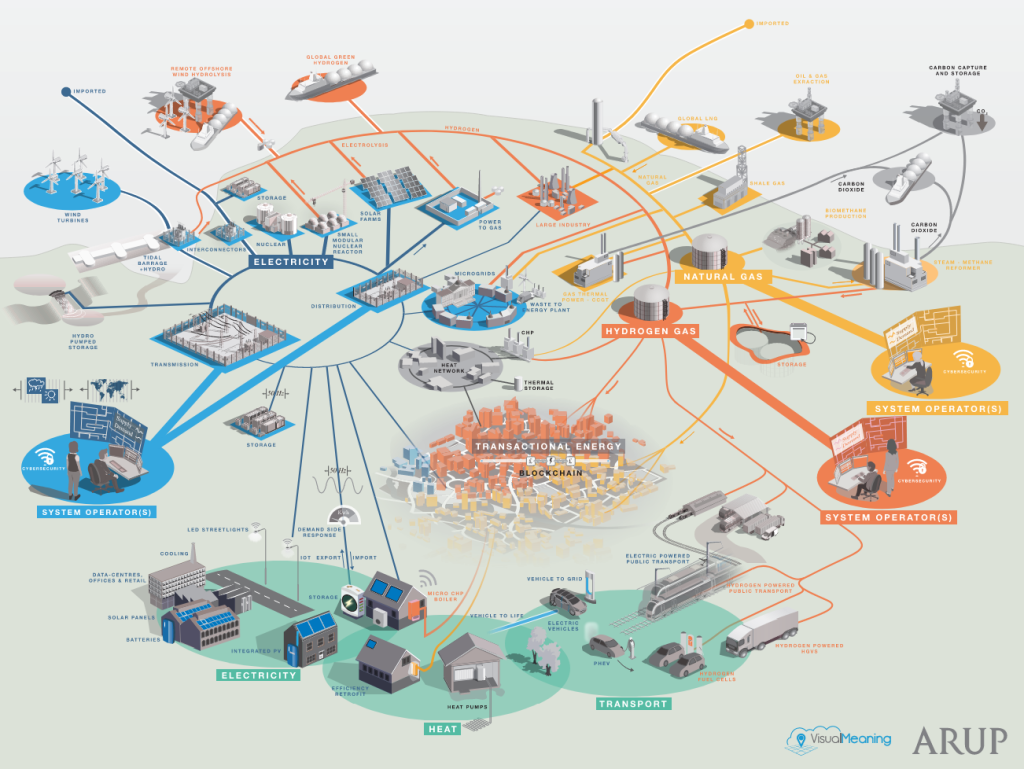
Globally, in regions like California, Türkiye, and the Philippines, geothermal power is deployed at scale to complement solar and wind, ensuring grid reliability, reducing curtailment, and reducing energy price volatility and exposure risk. These examples reinforce Arup’s view that geothermal is not a standalone solution, but a strategic enabler of integrated, low-carbon energy systems.
Ultimately, geothermal enhances the performance of other renewables by filling gaps in intermittency, enabling seasonal storage, and supporting whole-system optimisation.
How is Arup engaging with policymakers or local authorities to advance geothermal awareness?
Arup actively engages with policymakers and local authorities to raise awareness of geothermal energy and support its integration into low-carbon strategies.
In the UK, Arup contributes to national dialogue through participation in the Deep Geothermal All-Party Parliamentary Group (APPG), maintains close ties with the Department for Energy Security and Net Zero (DESNZ), and is a member of key industry working groups including the Geothermal Task Force. We have co-authored influential publications such as white papers for the Renewable Energy Association (REA), British Geological Survey (BGS), and Northern Ireland’s geothermal strategy; and recently published the UK geothermal energy review and cost estimations report, all of which help shape policy narratives and inform strategic decision-making.
At the local level, Arup works with councils and regional authorities to embed geothermal into heat network zoning, local energy planning, and sustainability frameworks. This includes regional mapping, demand-supply energy modelling, site identification, and supporting funding applications under schemes like the Public Sector Decarbonisation Scheme (PSDS). This is supported by Arup’s wider project development expertise, such as planning, permitting, environmental impact assessments, business modelling, and technical expertise.
Internationally, Arup has supported governments in the Philippines, advising on geothermal power tariff structures, and in Türkiye, where we developed a national mapping tool for ground source heat pump potential and pilot site selection.
Across all regions, Arup prioritises clear, accessible communication to engage non-specialist stakeholders and build confidence in geothermal solutions. Our approach combines technical expertise with strategic advocacy to ensure geothermal is recognised as a viable, scalable, and sustainable energy option.
What role do you see for large-scale engineering firms like Arup in creating investor confidence in UK geothermal?
Large-scale, multidisciplinary engineering and consultancy firms like Arup play a pivotal role in creating investor confidence in UK geothermal by providing trusted, independent expertise across technical, financial, and strategic domains.
Arup’s Business Investment and Advisory (BIA) team works closely with global investors to deliver robust due diligence, techno-economic assessments, and risk analysis for geothermal projects. We support refinancing, corporate transactions, and stakeholder engagement, helping investors understand market dynamics and project viability.
Together, our BIA and Geothermal team have supported projects worldwide, helping investors navigate subsurface risk, assess resource potential, and identify bankable opportunities. Our Ventures team also works with emerging geothermal start-ups, often academic-led and digitally innovative, providing technical and commercial guidance to strengthen credibility and accelerate growth.
Investors rely on documentation and reporting from firms like Arup because of our reputation for quality-assured, peer-reviewed analysis. We maintain the highest standards in our outputs, ensuring they are evidence-based, internationally benchmarked, and tailored to investor needs.
Ultimately, Arup’s role is to de-risk investment, build market confidence, and demonstrate measurable impact on project outcomes. By combining technical excellence with strategic insight, we help unlock capital flows into geothermal and other low-carbon technologies, supporting the UK’s energy transition.
What are the key technical barriers to scaling geothermal in the UK, and how is Arup working to address them?
While shallow geothermal systems are increasingly deployed in the UK, scaling geothermal, particularly deep geothermal, faces several key technical and structural barriers.
For shallow systems, closed-loop ground source heat pumps are well understood and widely adopted. However, open-loop and minewater systems remain less common due to regulatory complexity, site-specific hydrogeological constraints, and uncertainty around permitting timelines, which can delay projects and increase costs.
For deep geothermal, the UK has the technical expertise, drawing on transferable skills from the oil and gas sector, drilling specialists, and district heating engineers. However, scaling is constrained by limited deep onshore geological data, making resource targeting difficult; relatively high upfront capital costs and long development timelines; elevated subsurface risk profiles, especially in unproven areas; and lack of coordinated policy and regulatory support to enable early-stage financing and reduce investor risk.
Arup is working to address these barriers through a combination of strategic advocacy and project development support. We are actively promoting the need for a UK-wide geothermal exploration programme, targeting strategic public assets such as NHS hospitals, Ministry of Defence (MoD) sites, and universities, or large-industry clusters. This would generate valuable subsurface data, de-risk early-stage development, and build investor confidence.
We also advocate for a government-backed research and demonstration initiative, similar to the U.S. Department of Energy’s FORGE and Fervo projects, to progress enhanced drilling techniques, reservoir stimulation, and scalable well designs. Such programmes could significantly improve the economic and technical viability of deep geothermal in the UK.
Arup continues to engage with policymakers, investors, and local authorities to break the “chicken-and-egg” cycle, where government awaits private investment and vice versa, by providing evidence-based analysis, technical guidance, and strategic recommendations to accelerate deployment and support national decarbonisation goals.
What would a realistic roadmap for scaling geothermal in the UK by 2030 look like?
A realistic roadmap for scaling geothermal in the UK by 2030 must balance ambition with strategic investment, and policy reform.
While recent government Public Sector Decarbonisation Scheme (PSDS) funded projects, such as those at the University of York and Nottingham NHS Trust, signal growing interest, these alone will not generate sufficient momentum without broader support and targeted engagement.
Arup believes the roadmap should include the following key components:
- Continue supporting current geothermal initiatives to maximise learning, improve performance, and share insights across the sector. These projects should serve as demonstrators for replication and scale-up.
- Establish a large-scale, government and industry-funded research programme to test advanced drilling, reservoir stimulation, and scalable well designs. Drawing on international best practice such as FORGE and Fervo in the U.S., this initiative could unlock significant private investment by significantly reducing costs and advancing technical approaches.
- Develop a national geothermal exploration programme focused on public-sector and large industry sites such as NHS hospitals, MoD facilities, and universities. These projects can generate critical subsurface data, reduce early-stage risk, and build investor and local authority confidence.
- Appoint a dedicated governing body to oversee deep geothermal development and introduce supportive mechanisms such as risk sharing, geothermal heating tariffs, or Contracts for Difference (CfDs) to improve project bankability and attract investment.
- Accelerate rollout of ground source heat pumps and minewater systems through planning reform, installer training, and integration into local heat network zoning strategies.
Through coordinated efforts, the UK can harness its geothermal resources by 2030, laying the groundwork for a reliable, low-carbon energy future and playing a vital role in meeting national decarbonisation targets for 2035 and 2050.