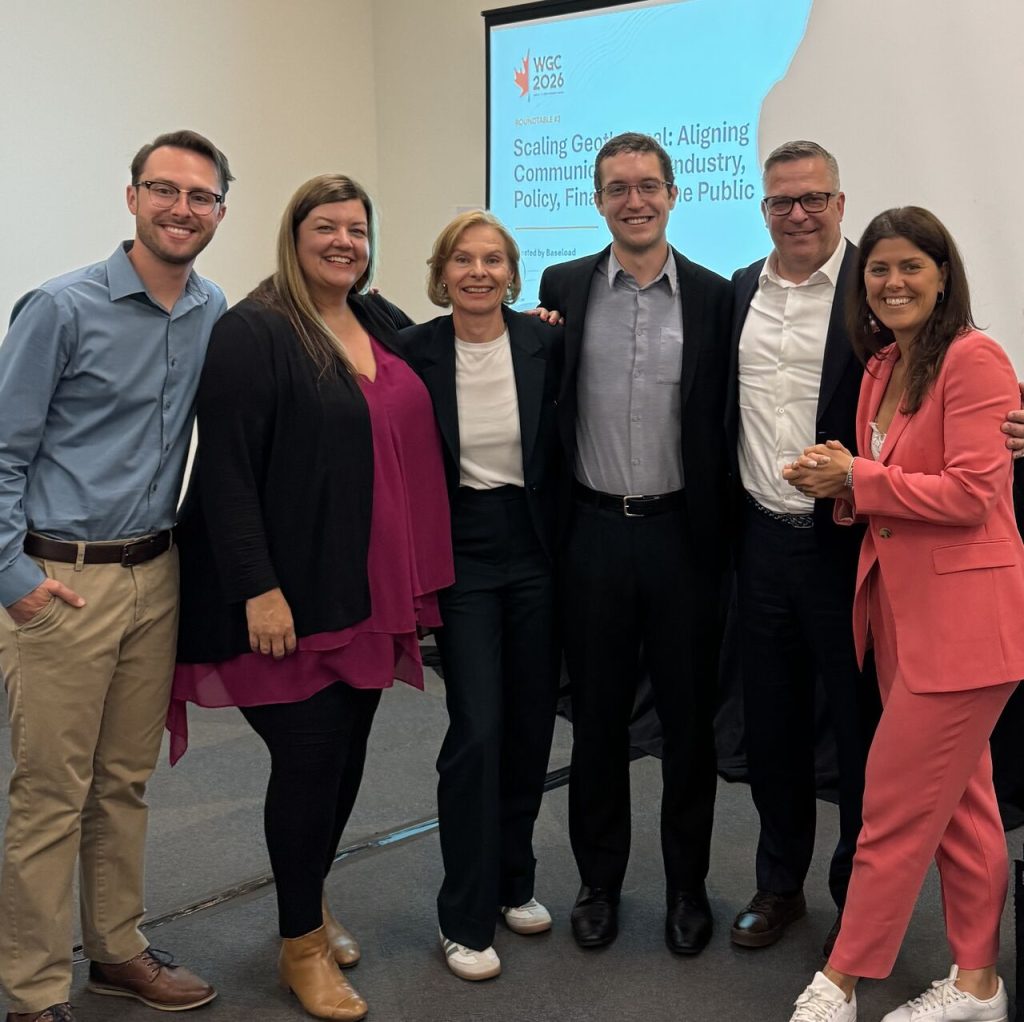
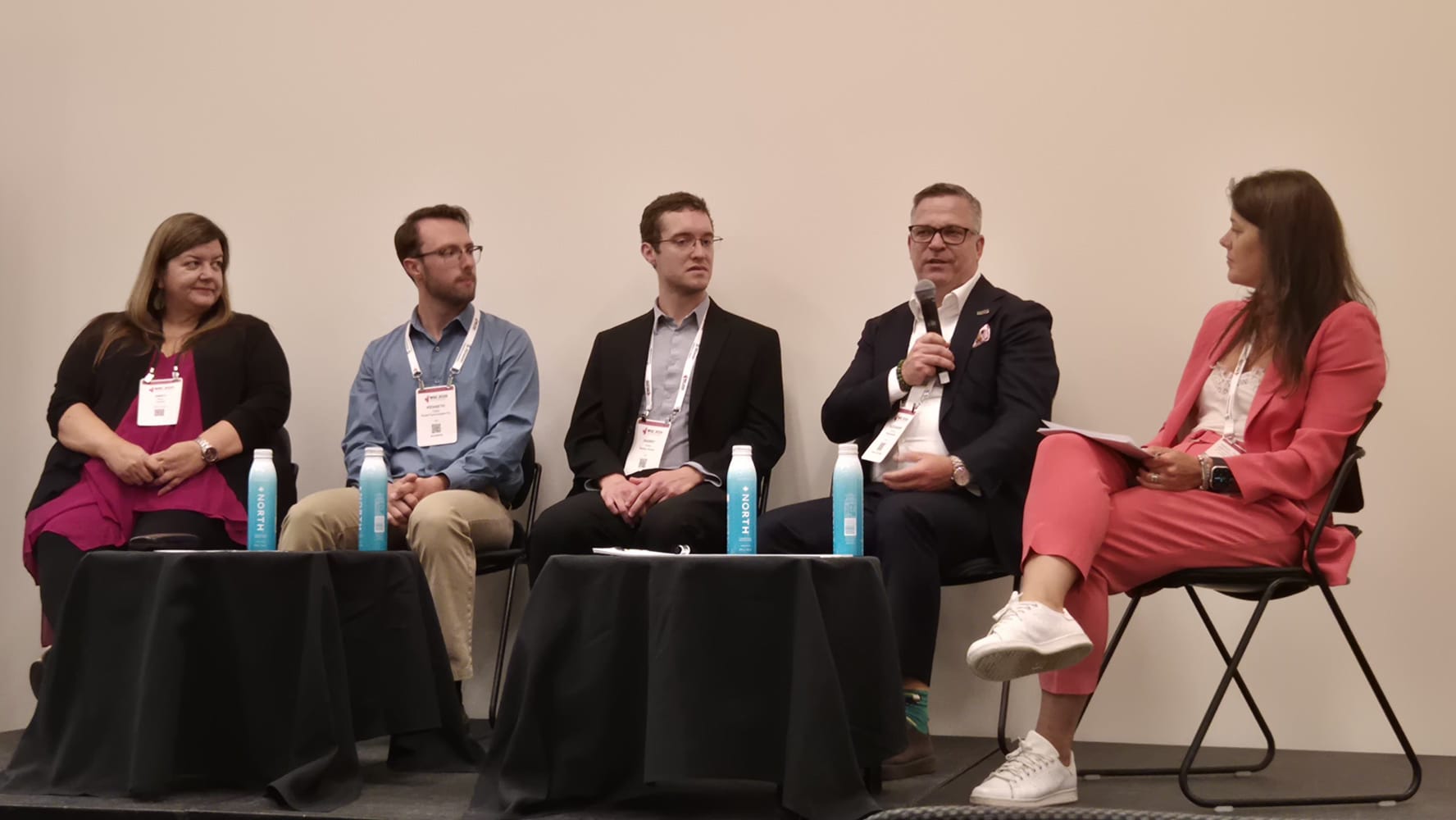
Clear, credible, and coordinated communication was the focus of a roundtable discussion held during the World Geothermal Congress 2026 in Calgary, bringing together industry representatives, communication professionals, policymakers, and financial stakeholders to explore how the geothermal sector can better communicate its value to different audiences. The panel was lead by Boel Stier of Baseload Capital (who shared a good summary post on LinkedIn on the event), with panelists Andrea (Andy) Blair of Upflow, Kenneth Vejby of Ormat Technologies, Inc., Harry Kelso of Quaise Energy, Kristina Hagström-Ilievska of Baseload Capital and myself representing ThinkGeoEnergy. As part of my role I then moderated the roundtable discussion that focused on investors, lenders and financial stakeholders.
Hosted by Baseload Capital as part of the ongoing Declaration of Communication initiative, the session aimed to identify communication gaps across the geothermal industry and develop recommendations that could help guide future efforts by the International Geothermal Association (IGA).
Rather than seeking a single industry-wide message, participants focused on understanding how geothermal is perceived by different stakeholder groups and what tools, examples, and best practices could help improve communication.
Identifying the communication gap
The session was structured around an interactive roundtable format led by Boel Stier of Baseload Capital, with breakout discussions focusing on three key audiences: investors and finance, policymakers and regulators, and the broader public.
In advance of the session, organisers emphasised that the goal was not necessarily to solve the industry’s communication challenges, but to identify where the gaps exist and determine how the geothermal community could learn from successful examples.
One recurring observation was that geothermal communication remains highly fragmented across companies, countries, technologies, and market segments. While this diversity reflects the breadth of the sector, it can also make it difficult for audiences outside the industry to understand what geothermal offers and why it matters.
Following the session, participants recommended that the IGA consider facilitating communication best practices, audience-specific resources, and a forum where geothermal communicators can regularly exchange experiences and lessons learned.
A finance perspective
One breakout discussion focused specifically on investors, lenders, and financial stakeholders.
The initial question posed to participants was straightforward: what information does the financial community need to better understand geothermal opportunities?
Interestingly, the discussion quickly moved beyond risk.
Investors generally understand risk. Assessing uncertainty, technical challenges, and project execution is part of their daily work. The conversation instead centred on whether geothermal is clearly communicating the factors that drive value creation.
Several themes emerged repeatedly.
Participants highlighted the importance of explaining scalability and repeatability. Investors often compare geothermal not only with other renewable technologies, but also with infrastructure, energy, and industrial investments competing for the same capital.
Questions were raised about how geothermal companies communicate market opportunity, portfolio development potential, revenue generation, and long-term growth strategies.
The discussion also touched on the distinction between upstream resource development and downstream energy demand. While geothermal developers naturally focus on resource quality and project delivery, investors often start from the demand side, asking where future revenue growth will come from and how projects can be replicated across multiple markets.
Another recurring theme was continuity. Participants noted that changing teams, shifting priorities, and evolving market narratives can create uncertainty for investors seeking long-term visibility.
One participant summarized the challenge with a familiar industry phrase: geothermal projects often present “When you have 20 problems and one that is money, you only have one problem” (thanks to Paul Cairns).” The communication challenge may be ensuring that the opportunity receives as much attention as the problems.
From technical discussions to value propositions
A broader observation emerging from the roundtable was that geothermal communication frequently begins with technical details.
Yet many audiences are more interested in outcomes.
For communities, that may mean affordable heating, lower electricity costs, energy security, or local jobs. For policymakers, it may mean decarbonisation, economic development, and energy resilience. For investors, it often means understanding how value is created, how projects scale, and how risks are managed relative to returns.
The challenge is not necessarily a lack of communication. It may be a question of tailoring communication to the audience receiving it.
Next steps for the Declaration of Communication
The roundtable discussions will contribute to recommendations being developed for the International Geothermal Association as it takes forward the Declaration of Communication initiative.
One proposal that received broad support was the creation of a global forum for geothermal communicators, including digital resources, regular exchanges, and dedicated sessions at major geothermal events.
As geothermal continues to attract greater attention from policymakers, utilities, technology companies, and financial markets, participants agreed that improving communication is no longer simply a marketing exercise.
It is increasingly becoming an important part of how projects gain support, secure financing, and move from concept to delivery.
Having these discussions show a clear professionalization of our geothermal sector with increasing interest in the broader aspects of geothermal that have been overlooked so far.
So thank you to Boel, Kristina and Baseload Capital for the facilitation.