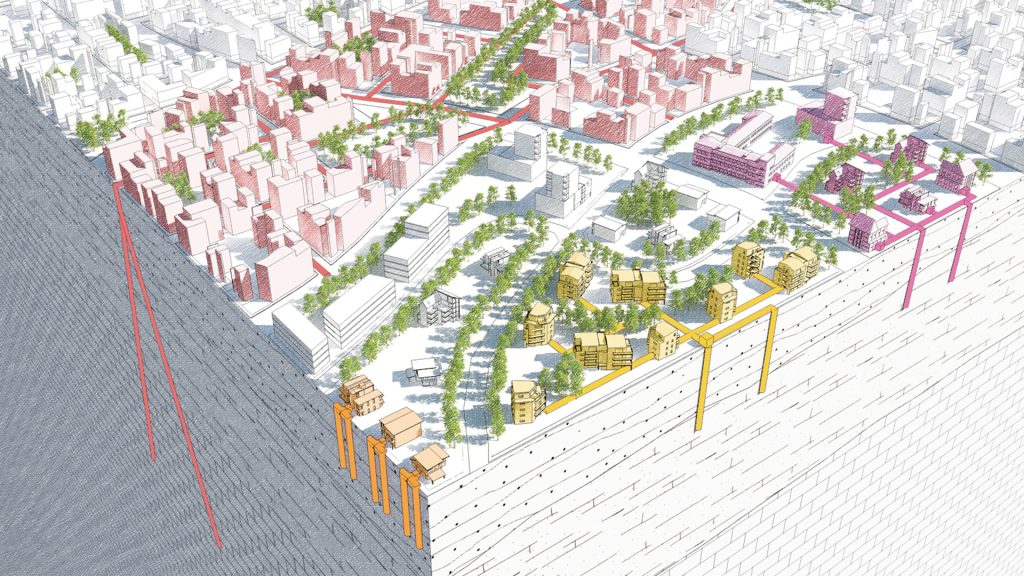
The results of the two-year GEOSCAN program have now been published, offering valuable insights on the geothermal potential in the west and south of the Île-de-France region in France. The study has now provided information on three key geological reservoirs which may host commercially exploitable geothermal resources for heating.
Despite the Île-de-France region hosting 54 active deep geothermal installations, making it the largest in Europe, its south and west regions are less developed, primarily because of incomplete subsurface knowledge. Thus, the GEOSCAN program was launched in November 2023 to better characterize the subsurface in these regions. ThinkGeoEnergy has reported on the different phases of the GEOSCAN program through the years.
Studies done under GEOSCAN program covered the vicinity of nearly 300 municipalities and area of almost 2000 square kilometers. Geophysical data acquisition was done over 280 kilometers across six departments of the region. Combined with 1660 kilometers of existing 2D seismic lines, 12 kilometers of electromagnetic geophysicla data, data from nearly 80 oil and geothermal wells, and numerous additional geologic measurements, a complete 3D geological model of the study area has been generated.
Through the study, new information on three key geological reservoirs has been documented:
- The Oxfordian, between 700 to 1600 meters depth, has never been exploited for geothermal energy in the Île-de-France region. With temperatures ranging from 40 ºC to 65 ºC, it is expected to be less productive than the Dogger aquifer. However, thermal fluids from this formation can be a major new resource for regional geothermal energy, especially if combined with heat pumps or as an extension of existing heating network. Information from the drilling in Alfortville will help provide more information on this resource.
- The Dogger formation is currently exploited by 54 installation, producing nearly 1.97 TWh of geothermal heat in 2025. The formation still hosts thermal fluids in the western and southern Île-de-France region, but is likely less productive in this region than in Paris. The study allowed for better identification of less favorable formations, such as impermeable marl facies, as well as potentially productive limestone formations. The temperature of thermal fluids in the Dogger aquifer range from 50 ºC to 80 ºC from west to east.
- The Triassic formations, also previously unexplored in the Île-de-France region, are now better understood structurally, and three reservoirs (Donnemarie, Chaunoy, and Boissy) of interest have been identified. Further targeted investigations, particularly local 3D seismic acquisition, will be needed to improve the understanding of these reservoirs and their potential for exploitation.
The results and data produced within the project are already partially available on the Geothermies website, under the GEOSCAN project results section. The technical results will improve preliminary studies conducted for local authorities and help reduce project risk.
Source: BRGM