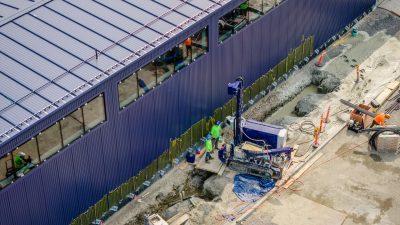
1515 Surf is a mixed-use complex built in Coney Island in New York City completed in 2024 by developer LCOR. What makes the facility unique is a geothermal bore field that provides heating during winter and cooling during summer, thus reducing both the carbon emissions for the building and utility prices for the tenants. It is also a testament to the long-term commercial viability of geothermal systems in dense, urban environments, despite the high initial costs.
ThinkGeoEnergy first reported on the project in 2022, but the plans for it have been in place since 2020. Construction topped out on 2023 and was completed by 2024. An essential component of the property was the geothermal system designed and installed by Ecosave USA. This system consists of a field of 153 boreholes, each drilled to depths of about 500 feet (152 meters), in a pattern that matches the footprint of the buildings.
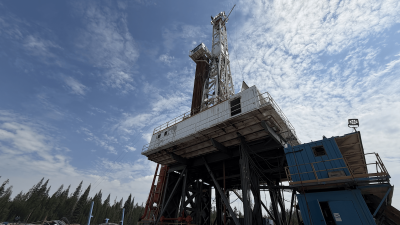
Ecosave started the work on the borehole field before construction began. This took about six months, including the drilling of the boreholes, installation of the piping, and constructing the mechanical room. As stated by Patrick Towbin, COO and chief of engineering at Ecosave, it is easier to install geothermal on the front end of a construction project rather than do a retrofit of an existing building. However, he anticipates that retrofits will get easier in the coming years as drilling technology improves.
High initial costs, decades of reliable and cost-effecitve utility
“The first costs of a conventional system are always going to be cheaper, but the total lifecycle costs of a geothermal system are going to be far more financially feasible,” said Arjun Mehta, Vice President of Ecosave.
Towbin adds that once projects get past the installation phase, building operators benefit from reliable, clean, and cost-effective heating and cooling that requires minimal maintenance. This is, of course, given that the system is installed according to specifications, and operated correctly. “There’s really very little other than chemistry maintenance, and some pumping maintenance and things like that. Other than the units that are actually fit out at the location, there aren’t as many workable parts or pieces of equipment as a conventional system. That’s overall why it’s cheaper to maintain for a long period.”
Public and private incentives help profitability
A package of public and private financial incentives helped the profitability of the 1515 Surf project. This included a $1.62 million grant from New York’s community heat pump pilot program, another $2.9 million from the utility clean heat program of utility Con Edison, and a 30% federal tax credit under the Residential Clean Energy Credit. The last incentive, however, will be gradually phased out starting 2033.
Towbin further adds a recent change in New York regulatory requirements will make geothermal systems even more efficient. In 2023, regulation was relaxed for geothermal boreholes drilled beyond 500 feet depth, making it easier to drill wells to 800 feet. This will make future projects even more economically feasible, as deeper wells allow for better storage of energy.
Source: Facilities Dive