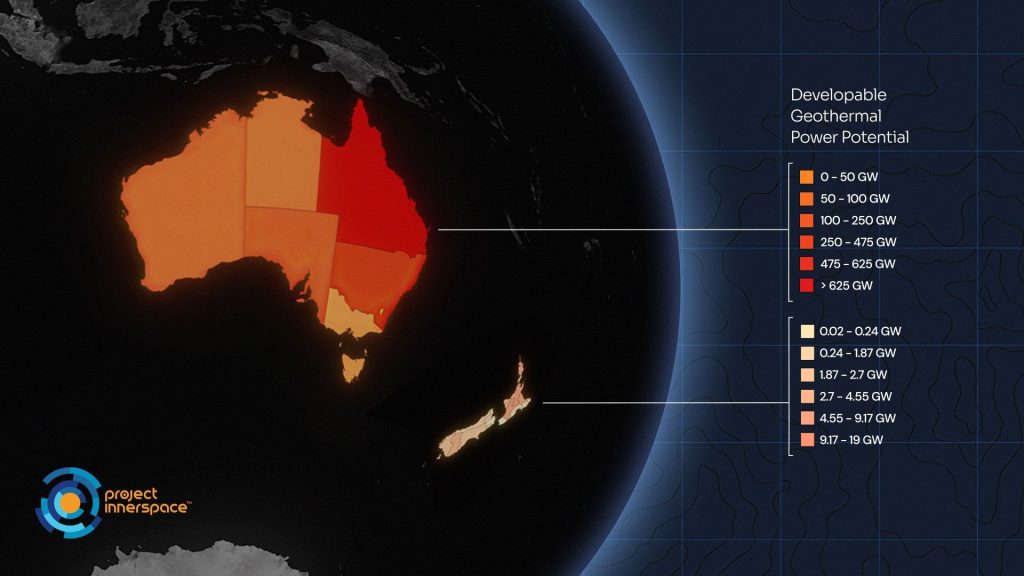
Project InnerSpace has launched GeoMap™ Oceania, a first-of-its-kind interactive mapping tool that integrates millions of surface and subsurface data points to highlight the massive geothermal potential in the region. Based on analysis done by Project InnerSpace using the tool, there is an estimated recoverable geothermal resource potential of 1,596 GW in Australia and 100 GW in New Zealand.
GeoMap™ Oceania uses millions of datapoints on heat flow, thermal gradients, temperature at depth, and heat-in-place volumes, alongside surface characteristics such as demand centers, industrial clusters, and access to transmission and other infrastructure, to identify where today’s drilling technologies can access geothermal heat for electricity, industrial heat, and district cooling.
GeoMap also highlights locations for geothermal powered and cooled data centers, industrial clusters that are candidates for geothermal heat conversion, coal plants that are candidates for geothermal power conversion, and locations that have subsurface energy storage potential, providing actionable insights for policymakers and project developers. As a follow on to this data release, a “Future of Geothermal in Oceania” report is in the early stages of development, which will function as a roadmap for tapping the region’s full geothermal potential, and consider topics such as investment pathways, supportive policy recommendations, strategies to accelerate development, and high impact pilot projects.
In New Zealand, conventional geothermal is already a major energy source given its position on a tectonic boundary, and GeoMap™ identifies significant additional opportunities for next-generation geothermal development there. Australia is a vast and untapped frontier for geothermal, with GeoMap™ showing opportunities for next-generation geothermal electricity and industrial heat despite the fact that it lacks New Zealand’s volcanic resources. Australia is also home to some of the world’s largest and hottest sedimentary basins, which are an excellent resource for district cooling in major cities like Sydney, Brisbane, Perth, and Adelaide.
“Until GeoMap, there was no easily accessible tool to help stakeholders understand and quantify the geothermal resources beneath them, and thus this ubiquitous resource has been overlooked,” said Jamie Beard, Executive Director of Project InnerSpace. “Australia is an excellent example of untapped potential – with 10X total energy demand hidden beneath the surface, and few indications on the surface that it is there. It is our hope that GeoMap will support stakeholders in advancing this massive but invisible potential into ‘wells in the ground’ development.”
Source: Project InnerSpace via PR Newswire