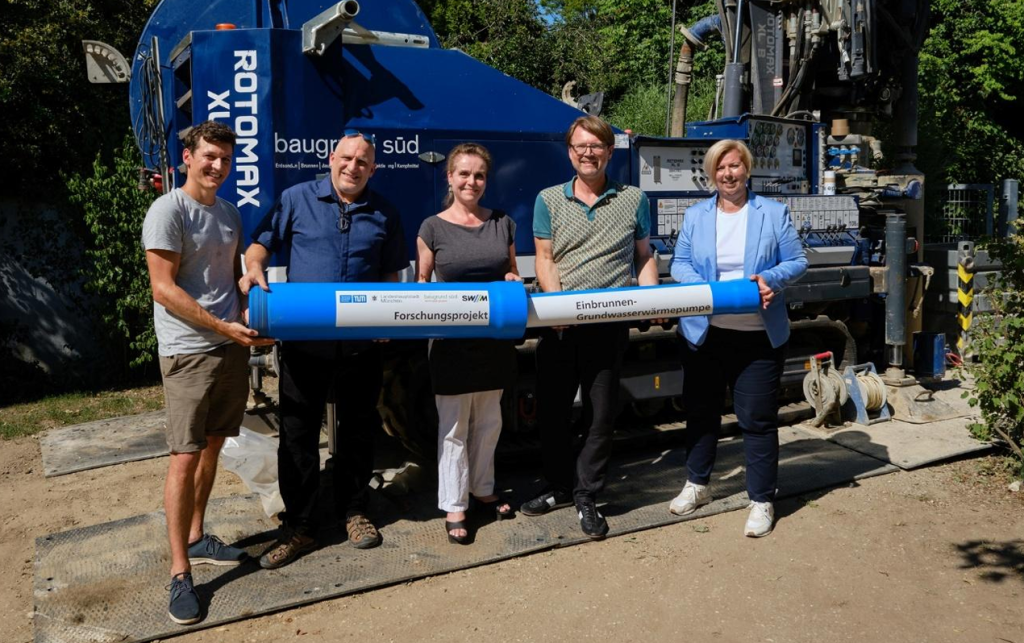
An innovative single-well system for geothermal heat pumps will soon be installed in the Pasing district of Munich, Germany which aims to make it possible to deploy geothermal heating solutions in urban locations with minimal space. Several tests will be done on the system in 2026, with full commissioning and heating system conversion scheduled in 2027.
The project is made possible through close collaboration between the Technical University of Munich (TUM), Stadtwerke München (Munich’s municipal utility), the City of Munich, and the well-drilling company BauGrund Süd.
A geothermal heat pump solution for urban areas
While the geothermal resource in Munich has already been well-studied and exploited for heat supply, the lack of space often presents an insurmountable hurdle. This is true for about one-third of the municipal and private properties in Munich, which are simply too small to accommodate a two-well system for water discharge and injection. To advance the heat transition, solutions need to be developed to enable geothermal heating even in places where substantial space is unavailable.
The single-well pilot seeks to address this gap. It adapts the successfully proven single-well coaxial probe system for use in highly permeable and more homogenous aquifers such as those found in Munich. The system differs from conventional coaxial probe systems by leveraging the high groundwater flow velocity, thus making groundwater heat pumps systems considerably more cost-effective.
“The unique feature of our system is that groundwater extraction and reinjection take place via a single well. An internal seal prevents cooled water inside the well from flowing directly back into the extraction zone. The relatively high natural flow velocity of the groundwater prevents this from happening on a larger scale within the aquifer itself,” explains Dr. Kai Zosseder, Chair of Hydrogeology at the Technical University of Munich.
“It is gratifying to see a theoretical research concept evolve into a practical solution capable of making a significant contribution to the heating transition.”
“With the single-well system, we are creating an opportunity to make groundwater heat pumps a viable and affordable option for a much wider range of users—thereby significantly accelerating the heating transition as a whole,” added Dr. Karin Thelen, SWM Managing Director for the Regional Energy Transition.
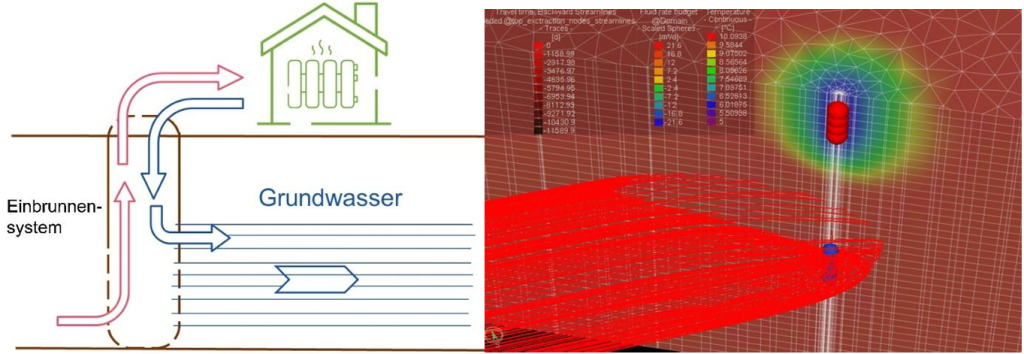
System testing and comparison ongoing
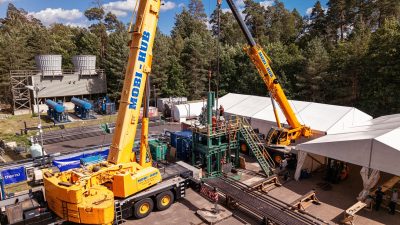
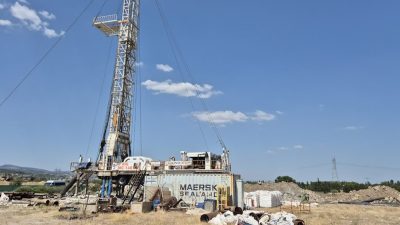
Prior to installation of the probes, groundwater monitoring wells were installed and pumping tests were conducted at the study site in Oselstraße in Pasing. This was done to determine hydrogeological conditions. Two wells were then drilled.
Two different single-well systems will be installed at the study site. The first features two parallel pipes in a single borehole, with one for water extraction and one for reinjection. The second system uses a pipe-in-pipe configuration, which is more space-efficient. Both systems have been designed to support the entire heating demand of the children’s centre at the study site.
Temperature and water level sensors have been installed within the wells. An array of temperature sensors have also been installed in the groundwater monitoring wells to track temperature changes at different depths. Tracers tests are also planned to evaluate the hydraulics of the single-well systems. These tests will all be done in 2026, looking towards commissioning and heating supply by 2027. The integrated system will then be continuously monitored through the course of its operations until 2029.
“I am very pleased that a municipal daycare center is serving as the pilot site for the Technical University of Munich’s innovative heat pump system. Education for Sustainable Development (ESD) is a guiding principle for all educational institutions in the City of Munich. And when the buildings themselves can also serve as practical, hands-on learning tools for the children, it is a win-win situation,” commented City Education Councillor Florian Kraus.
Source: Technical University of Munich