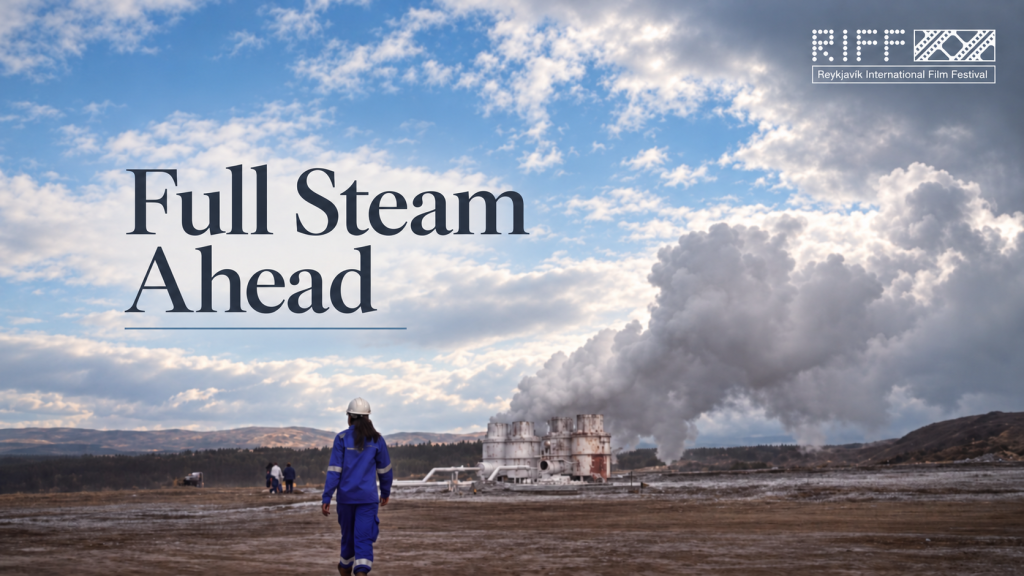
Full Steam Ahead has its Nordic premiere at the Reykjavík International Film Festival on Friday 26 September, 2026 at Háskólabíó – eight years after this publication first wrote about it, and six after it was meant to be finished. Another show will take place on September 30, 2026.
The 89-minute documentary was directed and produced by Susan Muska and Gréta Ólafsdóttir of Bless Bless Productions, with Heather Millard as co-producer and Compass Films co-producing. It follows women working in geothermal in three countries with serious resource: Iceland, Japan and Kenya. Two screenings are scheduled in the festival’s opening week – the premiere is followed by a panel discussion and reception, the second screening by a Q&A.
Reykjavík was always the plan.
“Our goal for premiering Full Steam Ahead has been to premiere in Reykjavík, as it’s such a steamy place and women are rocking the geothermal workplace,” Muska told ThinkGeoEnergy. “So we are thrilled that is happening. Yes, it’s been a long journey!”
Commissioned as a campaign film
The project did not start as the filmmakers’ own idea. Muska and Ólafsdóttir were approached by Erla Hlín Hjálmarsdóttir, then at the UN University’s Gender Equality Studies and Training Programme (UNU-GEST, now GRÓ GEST), and by Andrea “Andy” Blair, the founder of Women in Geothermal, to make a documentary about women in geothermal worldwide.
The original hook was a WinG campaign called “Go For No” – an effort to get women past the fear of rejection and asking outright, as Muska puts it, “for what they need to make the workplace equal.” One early approach was to film women in several countries asking for equality at work and being turned down.
The campaign framing fell away. So did most of the geography: early plans took in seven countries, including Ethiopia, Mexico, New Zealand and the United States.
“As you can imagine it would make for scant coverage of each location in a 90-minute film,” Muska said.
What survived is a film about barriers to advancement and the tactics women use to get round them, plus one chapter – filmed in Kenya – on a STEM camp that works on schoolgirls and their teachers early, before career choices harden.
Then COVID
When ThinkGeoEnergy covered the project in September 2018, it was funded by grants and corporate sponsorship and aimed at the World Geothermal Congress in Reykjavík in 2020. That was the start of the main production period.
“COVID came along and basically wiped out international travel and production, for almost two years, as we couldn’t film and interview people with masks on,” Muska said. “It’s too distracting, and risky.”
Filming resumed at the delayed congress in 2021, then continued with follow-ups in Japan and Iceland. Editing took another year and a half.
“As filmmakers, when you get involved in interviewing and filming you feel obligated, and also passionate, about getting the film done,” she said.
Those return visits matter for how the film reads now. Ask Muska whether interviews shot years ago have dated into a historical record and she is blunt that they have not: the team went back on camera in Japan and Iceland, “so the views expressed are current.”
What the women say
The film spans generations, and the generations sound different.
“More senior or retired women looking back on their experience routinely encountered sexist remarks or were blatantly treated as invisible,” Muska said. “But even today there is a downplaying of young women’s capability in STEM fields, including geothermal.” Being the only woman on a site, she added, still leaves plenty of them feeling excluded.
What linked the interviewees across Reykjavík, Tokyo and Nairobi was cruder than any of that. “Most of the women were connected by simply being women working in a ‘man’s world’,” she said. “It’s amazing how, no matter how much equality is legislated and promoted as positive and indeed necessary, the traditional social norms can push through.”
Some of the sharpest detail is structural rather than hostile. Kenyan women in the film describe being left out of after-work socialising “by choice” – they have families to get home to, and, as Muska relays it, they had no interest in going out for beers with colleagues anyway.
She is clear about what has improved. There are more women working as electricians, drilling engineers, environmental scientists and geologists than when filming began. “They still are ‘proving’ they are capable, and as there are more of them they are seen less as anomalies.”
Above a certain level, the picture is worse. “There is still a very male-dominated culture in energy, mining, etc.,” she said, and executive decision-making remains thin on women. Her answer to the question the project set out with – why so few women enter geothermal, and why so many leave – has barely moved: “it’s still difficult for women to get beyond a certain level of status.”
Iceland is not exempt, which should interest readers here. Muska calls it “way ahead of the game due to so many rights concerning equality in employment” – and then points out that even here, women are leaving senior positions for other sectors where they expect a better job. The film’s counter-example is Edda Sif, who has built her own niche and stayed in it for love of the work.
And she does not think any of this is safely won. “Globally there is a new backlash against women’s rights and equality, so I’d say no one can take any progress for granted.”
“You can do it”
Asked what she wants a young woman weighing up geothermal, geology or engineering to take from the film, Muska does not hedge: “You can do it!”
The mechanism the film keeps returning to is visibility. Marit Brommer’s line in the documentary – “you can’t be what you can’t see” – is the argument for mentors and role models in one sentence. The Kenyan STEM camp is the same argument applied fifteen years earlier in a career. So, in a different way, is the GRÓ Geothermal Training Programme in Iceland, which runs under the auspices of UNESCO and puts women engineers and scientists from geothermal countries into an international professional setting – and, Muska notes, exposes them to the idea of equality at work and at home.
For a sector currently trying to hire at a pace it has never hired at, that is not a side issue. It is the recruitment pipeline.
Where it goes after RIFF
Festivals first, then the sector. Muska and Ólafsdóttir want screenings at conferences and in university geology, geophysics and engineering departments, and say requests have already come in. Women-in-energy networks – WinG, the Icelandic women-in-energy association, and their counterparts elsewhere – are the other obvious route, at conferences and members’ meetings. A distributor will be lined up once the festival run is over.
Full Steam Ahead screens at Háskólabíó on 26 September, with a panel discussion and reception afterwards, and again on 30 September followed by a Q&A. Tickets are available through RIFF.
Disclosure: ThinkGeoEnergy has followed this project since 2018 and has covered its progress in the years since.