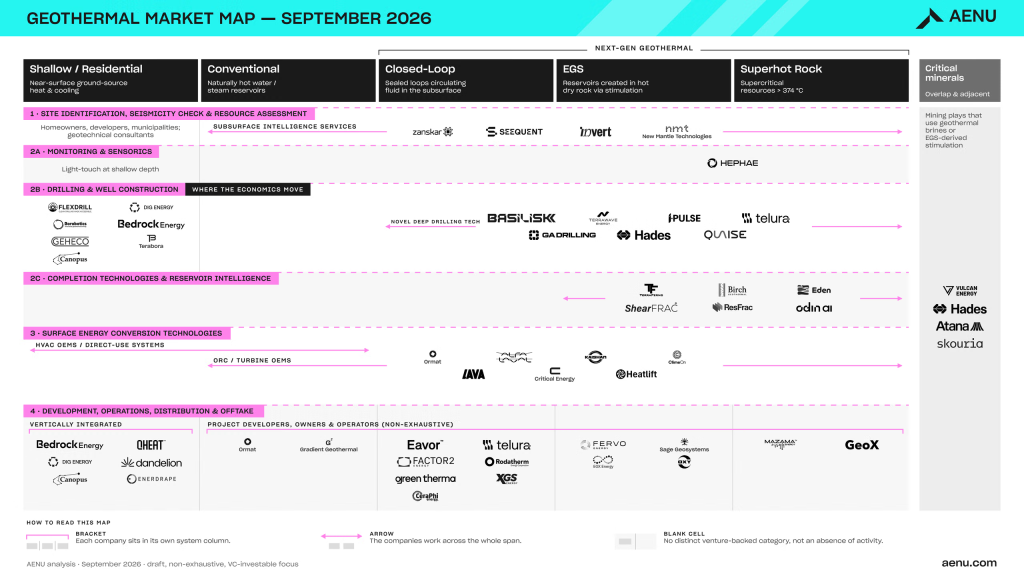
A new geothermal market map from European climate-tech investor AENU offers a useful snapshot of a sector that is attracting more companies, capital and technical approaches, while becoming increasingly difficult to describe through technology alone.
Published with the analysis Geothermal has split in two, the September 2026 map covers more than 50 companies across shallow geothermal, conventional hydrothermal, closed-loop systems, enhanced geothermal systems (EGS), superhot rock and geothermal-linked critical minerals. It also follows activities across subsurface services, drilling, reservoir technologies, energy conversion and project development.
AENU is clear about its perspective. The map has a “VC-investable focus”, while AENU itself invests in the technology layer at Seed and Series A. At the same time, the map already acknowledges how much crossover exists. It includes vertically integrated companies and uses arrows and repeated company placements to show activity across different parts of the value chain.
That makes it an interesting starting point for a wider discussion about where the geothermal market is heading.
Technology, development and business models converge
Geothermal has always been difficult to place into neat categories. That is becoming more pronounced as companies combine technology development with project development, ownership and energy sales.
GreenFire Energy, for example, describes itself as a technology-agnostic geothermal developer, combining advanced geothermal systems, EGS and conventional approaches depending on the resource. Its stated goal is to develop 150 MWe by 2030.
Vulcan Energy sits across another boundary. Its Lionheart project in Germany combines geothermal heat and power with lithium production. The project’s EUR 2.2 billion financing package reached financial close in May 2026, illustrating both the potential for geothermal-linked business models and the scale of capital required once projects move beyond technology development.
Similar overlaps are appearing in geothermal heating, where developers, infrastructure investors, utilities and technology suppliers can take very different roles. Recent discussions around Heat-as-a-Service and portfolio financing are one example of how geothermal deployment increasingly depends as much on ownership and financing structures as on the underlying technology.
The US validates power, Europe builds heat
AENU’s central thesis is captured in one line: “the US validates power, Europe builds heat.”
There is substance behind that distinction. In the United States, much of the current next-generation geothermal momentum is being driven by demand for firm electricity, including from data centres and large corporate buyers. AENU argues that signed offtake is particularly important because it can turn a drilling programme into an asset against which lenders are willing to finance.
Europe starts from a different base. Geothermal heat is already an established market, particularly in district heating. The latest European Geothermal Energy Council market report counts 434 operational geothermal district heating and cooling systems with more than 6 GWth of combined capacity, alongside more than 500 projects under development. Across the EU, the stock of geothermal heat pumps has also passed 2.5 million units.
The distinction should not be read as a hard divide. European projects are also pursuing power, while North America has a sizeable heating and cooling market. Projects such as Lionheart combine heat, power and minerals within a single development.
Still, AENU’s framing points to an important difference in market pull. In the US, firm electricity contracts are becoming an important route to scale. In much of Europe, heat networks, municipal energy systems and industrial heat demand provide another pathway.
Drilling remains a hard constraint
One of the strongest elements of AENU’s analysis is its focus on what still has to improve technically.
For deep geothermal power in much of Europe, the challenge quickly becomes one of drilling deep, hot and hard crystalline rock. AENU notes that stimulation rules in Germany restrict the US-style EGS route in some geological settings, while Europe also has fewer of the large drilling rigs needed for very deep wells.
AENU summarises the issue plainly:
“The whole case narrows to a single lever: how fast, and how cheaply, you can make hole through hard rock.”
The economics support that focus. AENU cites US National Renewable Energy Laboratory estimates putting drilling at 30% to 57% of capital expenditure. The International Energy Agency takes a broader view of next-generation projects and notes that drilling and well costs can represent as much as 80% of total costs in some cases. The figures differ in scope, but both point in the same direction: subsurface execution remains central to project economics.
Closed-loop systems offer one route around some reservoir and stimulation constraints, while superhot rock could eventually extend the opportunity further. Both still depend on reliable drilling, high-temperature tools and successful field execution.
AENU uses Eavor’s Geretsried project in Germany as a reality check. The project has so far delivered between 0.5 and 1 MWe gross from the first loop against an original 8.2 MWe overall design target, with further loops yet to be drilled. Whatever the eventual outcome, it is a reminder that moving from a technical concept to repeatable commercial performance remains difficult.
Capital is arriving, but projects need more than venture funding
The investment momentum around geothermal is real.
International Energy Agency figures show financing for next-generation geothermal reaching almost USD 2.2 billion in 2025, up around 80% year on year. Conventional geothermal power attracted close to USD 5 billion, while geothermal heating projects received more than USD 11.5 billion.
AENU also points to an encouraging shift in how projects are financed. Equity’s share is declining as project debt becomes available, with Fervo’s non-recourse financing and Vulcan’s project package among the examples cited.
That progression is important. Successful venture financing can help prove a drilling method, reservoir concept or new piece of equipment. Commercial deployment then requires a different scale of capital for wells, infrastructure, permitting, power plants, heat networks and long-term operations.
The IEA describes this as a “missing middle”, where projects can become too capital-intensive for venture investors before they have become sufficiently de-risked for traditional infrastructure capital. The US Department of Energy’s USD 171.5 million 2026 funding opportunity for field-scale testing and exploration drilling is one example of public funding aimed at helping technologies and resources cross that gap.
From successful projects to repeatable portfolios
This is where the next stage of geothermal growth may be decided.
The industry has many technically successful projects. Scaling from those projects to portfolios requires repeatability in exploration, drilling, permitting, procurement, financing and operations.
There are different ways to build that scale. Some developers seek to deploy one technical platform repeatedly across multiple projects. Others start with the resource and portfolio rather than the technology. Ignis Energy, for example, describes itself as a technology-agnostic, portfolio-driven geothermal developer, matching individual resources with conventional hydrothermal, closed-loop or EGS approaches depending on geology and commercial conditions. The company is building a multi-project portfolio across several markets, with the aim of turning de-risked geothermal resources into investable power projects.
A third route can be seen in geothermal heat, where smaller projects may be aggregated into portfolios large enough for infrastructure investors. Across these models, the common thread is the move away from treating every geothermal development as an isolated project.
For geothermal, scale has rarely been about technology alone. Resource risk, local geology and drilling will continue to matter. So will the ability of developers to turn technical progress into projects that can be financed and repeated.
There is good reason for optimism. Investment is increasing, drilling performance is improving in some settings, new buyers are entering the market and geothermal is being considered for a wider range of power, heat and mineral applications.
At the same time, the move from promising technology to a bankable portfolio remains a demanding one.
AENU closes its analysis by asking, “Who are we missing?” From a broader project-development perspective, some of the answer may lie beyond another technology company. Heat developers, utilities, portfolio aggregators, infrastructure investors and integrated energy-and-minerals projects are becoming part of the same geothermal picture.
That does not make the market map less useful. It shows just how quickly the sector around it is evolving.
Source: Allgoewer, Leo (AENU): “Geothermal has split in two”