Seismic surveys in the greater Munich area in Germany for the “GIGA-M” research project are set to start by the end of August 2026 based on the current planning status, as stated by the project partners at a recent press conference. This is set to be the most comprehensive seismic survey to date to explore geothermal potential in Germany.
First announced in 2023, the GIGA-M project (Large-Scale Integrated Analysis of the Deep Geothermal Potential and its Synergistic Use in the Greater Munich Area / Großräumige Integrierte Gesamt-Analyse des tiefengeothermischen Potentials und seiner synergetischen Nutzung im Großraum München) will involve a large-scale 3D seismic survey to produce a high-resolution, three-dimensional model of the subsurface of the study area.
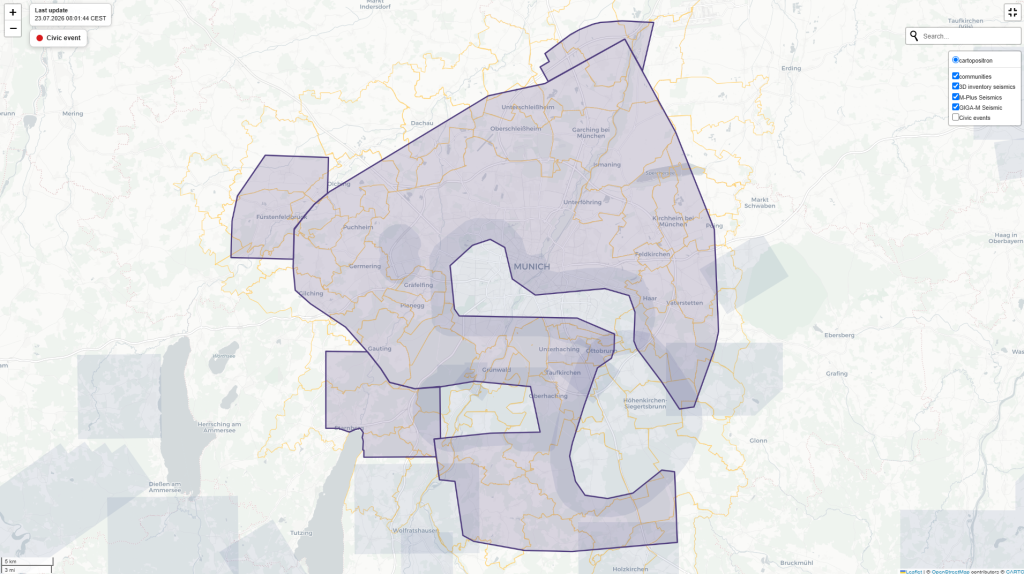
The seismic survey will cover an area of approximately 1100 square kilometers. The new data that will be collected from these surveys will be combined with data from existing boreholes and previous measurements, generating the most comprehensive subsurface model of the greater Munich area.
Currently, the geothermal reservoir in the greater Munich area is already being utilized by approximately 50 boreholes with a total thermal output of about 400 MW. The remaining potential is estimated at more than 1,000 MW. The large-scale 3D seismic survey campaign will close existing data gaps, thus creating a model that will help identify structures, water-bearing strata, and potential locations for future geothermal drilling at significantly higher precision. This model will be made available for free to all interested parties after the project is completed.
The GIGA-M project is being jointly executed by the Technical University of Munich (TUM), Stadtwerke München (SWM), Energie-Wende-Garching (EWG), the city of Munich, and the Munich district. Funding for the project has been provided by the Federal Ministry for Economic Affairs and Energy (BMWE).
According to the details revealed during the joint press release on the project, the projected schedule of the seismic surveys is as follows:
- August – Southern district of Munich, Bad Tölz-Wolfratshausen, Miesbach, Starnberg and Fürstenfeldbruck
- September – Fürstenfeldbruck, Dachau, parts of the Munich city area
- October – Other parts of the city of Munich, Dachau, Freising
- November – Ebersberg, Erding
Beyond the seismic surveys, the GIGA-M work package also includes the deployment of Extended Reach Drilling (ERD), aiming to extend the horizontal sections of geothermal wells to better access reservoirs and reduce the number of wells needed to support geothermal projects. Another work package involves numerical modeling of the reservoir to ensure that geothermal wells do not negatively impact each other. This is particularly important as new geothermal plants are being planned in the Munich area.
“According to one study, geothermal energy could cover around 25 percent of Germany’s heating needs nationwide, while another study sees a potential of over 65 percent in the greater Munich area alone,” said Dr. Kai Zosseder, GIGA-M project manager, TUM Munich, Chair of Hydrogeology
“A reliable data foundation is essential for future-proof and dependable planning and the sustainable use of geothermal potential. We are creating this foundation with seismic measurements. Based on this data, we can develop cross-municipal and cross-border energy alternatives to fossil fuels for the people in the region.”
Source: Landratsamt München and GIGA-M