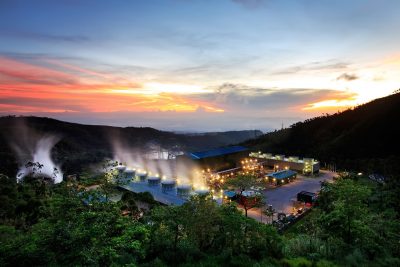
The National Geothermal Association of the Philippines (NGAP) is calling for better tax incentives, funding support for technology innovation, and a restructured pricing scheme to encourage the growth of the geothermal power sector in the Philippines. The appeal was made by NGAP President Jaime Jemuel Austria at a roundtable during the recently held 7th Philippine International Geothermal Conference in Lipa City, Batangas.
As Austria explained, early geothermal development has primarily focused on prime locations with higher potential. Developing the remaining sites can be more costly, whether because of resource quality or the lack of access and infrastructure. For this reason, government aid is being sought to utilize these geothermal resources outside of the conventional model.
Austria pointed out that during the last round of the Green Energy Auction (GEA), only 30 MW was taken up by the industry out of the 100 MW offered by the government. A technical working group was thus reconvened to identify areas of improvement and increase industry uptake for the next round of the GEA.
A proposal coming out of that discussion is to have a more dynamic pricing mechanism for geothermal projects to account for site-specific development costs. For instance, he pointed out that a project on relatively flat terrain may have lower costs for road construction and site preparation. On the other hand, developing a geothermal project in mountainous terrain would already be more costly, even during the exploration and drilling phase.
“It’s not ideal to have just one price. That’s what we’re advocating for – to capture the true cost of geothermal,” said Austria in an interview.
Extending tax relief and financing research
Austria also stated that extending the tax relief period for geothermal projects is another way to ease the costs of geothermal development. Under the current rules, geothermal projects have a seven-year income tax holiday.
Another proposed measure would help geothermal companies with research and development projects. Developers can tap the Renewable Energy Trust Fund (RETF), which is a facility that has been established to provide grants, loans, equity investments, and insurance to expand renewable energy knowledge, conduct studies, and finance aligned activities.
According to Austria, the NGAP is already aligning with the Department of Energy (DOE) and the Department of Science and Technology (DOST) to identify eligible projects.
Previously the country with the second highest installed geothermal power capacity in the world, the Philippines slid down to the 3rd place below Indonesia in 2018. The rate of growth of the sector in the Philippine has since slowed down, but Energy Secretary Sharon Garin stated that the country currently has around 2100 MW of untapped potential. Unlocking this potential would require an estimated investment of USD 12.6 billion.
The proposal financial schemes, as well as the recently launched de-risking facility, coupled with the Philippines’ excellent geothermal resources and a rich history of development expertise, provide enough moving parts for the country to mount a geothermal resurgence in the coming years.
Source: Manila Bulletin and Philippine Star