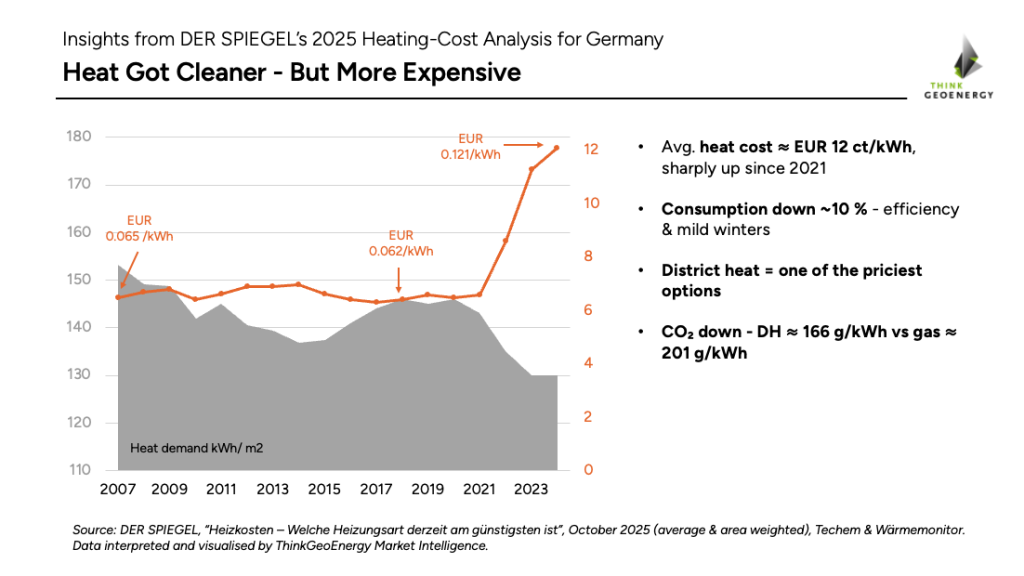
Heating homes in Germany has become noticeably more expensive. According an analysis published today in German publication DER SPIEGEL (October 2025 analysis of household heating, the national average cost has reached about EUR 12 cents per kWh, sharply higher than in 2021.
Even though average heat consumption per square metre fell roughly 10 percent thanks to efficiency upgrades and milder winters, households still face higher bills overall.
District heating, long viewed as a clean and convenient option, now ranks among the most expensive systems. Yet its CO2 intensity has improved, averaging 166 g/kWh compared with 201 g/kWh for natural gas. Roughly one-third of multi-family homes (32 percent) now rely on district heating networks, underscoring their central role in urban energy supply.
A market under pressure
The price surge reflects fuel volatility, infrastructure costs, and rising CO2 prices. For operators, this means growing pressure to stabilise tariffs while decarbonising. For consumers, it highlights that the heating challenge is no longer just about efficiency, it’s about price stability and carbon exposure.
As the power sector adds more renewables, electrification through heat pumps is becoming increasingly competitive. That structural shift positions geothermal heating as a key winner in Germany’s long-term energy transition.
Geothermal: stable, local, and scalable
Geothermal energy offers what the heating market needs most, reliability. Once developed, geothermal systems draw on an underground heat source that remains constant year-round. Their costs are largely fixed upfront rather than driven by global fuel prices.
- Ground-source heat pumps (GSHPs) use shallow geothermal energy for homes or neighbourhood networks (Quartierslösungen).
- Deep geothermal plants can feed municipal or district heating systems, supplying CO2-free baseload heat.
- Hybrid systems pairing medium-temperature wells with large heat pumps are emerging as cost-efficient municipal solutions.
Together, these approaches deliver predictable costs, minimal carbon risk, and energy independence, turning geothermal into both a technical and financial stability asset.
From cost shock to opportunity
With heating costs rising, the narrative is shifting from cheap gas to stable heat. District heating operators and municipalities are now looking to lock in long-term price certainty. Geothermal resources provide exactly that: local, renewable heat unaffected by global fuel swings.
Germany’s geothermal activity is accelerating, from new wells in Bavaria and the Upper Rhine to feasibility studies in Berlin, Hamburg, and Hanover. Paired with large heat pumps and supportive regulation, these projects could redefine how urban heat networks operate.
Outlook: stable heat Is the new cheap heat
The message from DER SPIEGEL’s 2025 heating-cost data is clear. Volatile fuels are costly; stability wins. Geothermal energy combines price predictability, local value creation, and real decarbonisation, the mix Germany’s heating transition needs most. If the city utilities (Stadtwerke) will though give it a real shot will have to be seen with news imminent on political support, such as a law to help speed up permitting and a potential support scheme helping to mitigate exploration risk and with that challenges in securing funding.
Analysis based on DER SPIEGEL (Oct 2025) “Heizkosten – Welche Heizungsart derzeit am günstigsten ist.” (behind paywall) Charts and interpretations by ThinkGeoEnergy Market Intelligence.