Ireland is moving to unlock more of its geothermal heating potential, with new Geological Survey Ireland (GSI) modelling pointing to substantial shallow and deeper heat resources beneath Dublin.
In central Dublin alone, GSI estimates around 4.5 TWh per year of shallow geothermal energy could be available under a commercial heating scenario. That is more than four times the commercial and public-sector heat demand of the city centre. The figure has also been presented previously in GSI work on decarbonising Dublin.
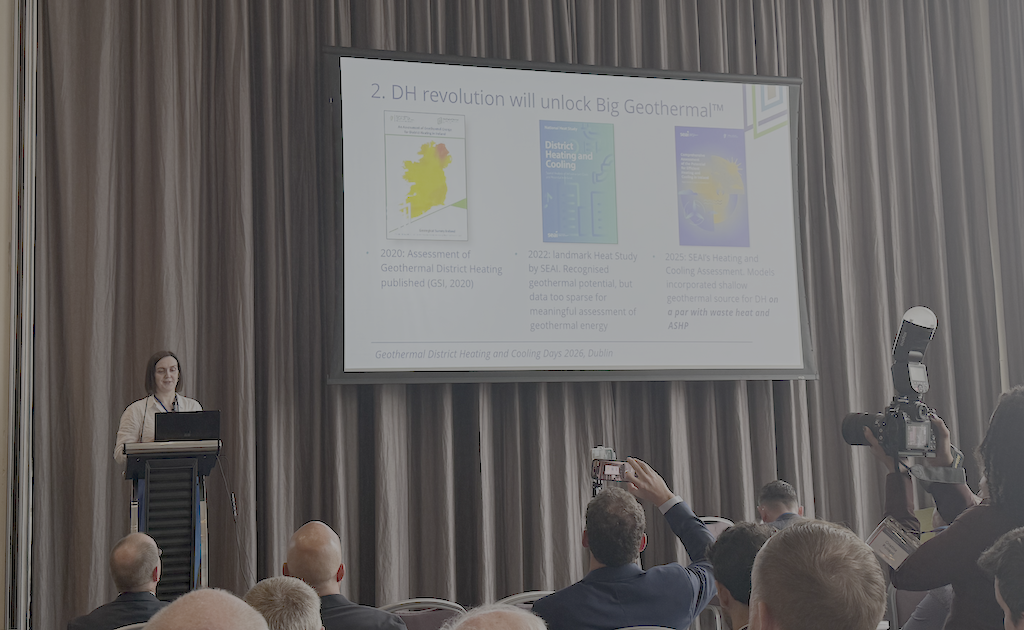
Dr Sarah Blake, Head of the Geothermal Programme at GSI, presented the findings on 3 September at the Geothermal District Heating & Cooling Days 2026 in Dublin. The two-day event, organised by the European Geothermal Energy Council (EGEC) and the Geothermal Association of Ireland (GAI), is focused on unlocking geothermal heating and cooling markets across Europe.
“Shallow geothermal heat is everywhere,” Blake told participants.
From geological maps to usable heat
Ireland’s shallow geothermal resource is already relatively well understood. Around 94% of the country is classified as either suitable or highly suitable for shallow geothermal applications using ground-source heat pumps.
Blake stressed, however, that geological potential alone does not mean a system can be installed everywhere. Dense urban areas, terraced housing and limited access for drilling equipment can create practical constraints, making shared ground loops or heat networks more relevant in some locations.
GSI is therefore trying to move beyond simply showing where geothermal resources exist.
Blake described the approach as moving from “maps to metrics”, with geological information increasingly combined with estimates of energy availability, costs, carbon savings and project requirements.
At the centre of this effort is GSI’s National Geothermal Database, first developed as a project in 2021. It brings together geothermal and drilling data, research and new subsurface information with the aim of reducing geological uncertainty and making geothermal projects easier to assess.
GSI has also developed a three-dimensional geothermal model covering around 40% of Ireland, including the Dublin Basin and much of the Midlands, according to Blake.
For County Dublin, GSI’s shallow geothermal modelling suggests that the available resource could theoretically support heating and cooling demand equivalent to almost 500,000 B1-rated homes.
The numbers describe resource availability rather than immediately developable capacity, Blake cautioned. Actual deployment will depend on access, drilling conditions, heat demand and the ability to connect suitable users to the resource.
District heating could open a larger market
District heating could be one of the main ways of turning that resource into usable renewable heat.
Blake described Ireland as being on the cusp of a major expansion of heat networks, which could make geothermal and other renewable or recovered heat sources economically viable at a larger scale.
The potential is substantial. The Sustainable Energy Authority of Ireland (SEAI) estimates that district heating could supply heat to around 54% of Irish buildings.
Ireland’s latest National Comprehensive Heating and Cooling Assessment goes further in assessing the near-term economic opportunity. Its technical analysis identifies economic potential for district heating to supply around 17% of current building heat demand, equivalent to approximately 4.6 TWh.
The assessment also gives geothermal a more prominent role than earlier national heat modelling, reflecting the improvement in available resource data.
For Blake, heat networks are particularly important because they allow geothermal projects to connect to concentrated demand rather than requiring every individual property to develop its own system.
Deeper geothermal potential beneath Dublin
GSI is also improving its understanding of deeper geothermal resources beneath the capital.
Blake presented results from the three-dimensional Dublin Basin model showing areas in South Dublin where limestone formations are more than 2.5 km thick and expected temperatures exceed 70°C.
Subject to finding sufficient fluid flow, such conditions could potentially support direct-use geothermal heat for district heating.
Other areas with temperatures above approximately 50°C could potentially be developed using large heat pumps.
The uncertainty is important. Unlike shallow geothermal, where the resource is well established, deeper projects require much better information about reservoir properties and fluid flow before investors can assess the commercial risk.
“On the deep subsurface side, this is a large uncertainty. It’s a large project risk at the moment,” Blake said.
GSI’s strategy is therefore focused on acquiring the geological data needed to reduce that uncertainty.
Dublin demonstration moves toward deeper drilling
A central part of that work is the GEMINI geothermal project at Technological University Dublin’s Grangegorman campus.
An earlier exploratory borehole at the site reached a depth of 1 km and recorded a temperature of 38.5°C. ThinkGeoEnergy reported on the result in 2023, when researchers said the higher-than-expected geothermal gradient justified further investigation of the Dublin Basin.
The wider GEMINI initiative now includes plans for a deep geothermal pilot at TU Dublin, with a borehole of around 2 km intended to improve understanding of the deeper resource and its potential to contribute to the campus district heating system.
Blake said the next step will be a new seismic survey through Dublin. Data acquisition is planned for 2027, with a two-week survey programme designed to improve targeting for deeper exploration drilling.
The work is expected to lead into an urban drilling demonstration at Grangegorman in 2028.
TU Dublin and the Grangegorman Development Agency have a longer-term interest in using geothermal heat to help decarbonise the district heating system serving the campus.
The demonstration could also have significance beyond the individual site. Better information on Dublin’s deep limestone formations could reduce exploration uncertainty for future geothermal heating projects elsewhere in the basin.
Building the case for larger investment
Blake concluded by outlining what a much larger geothermal resource-development programme for Ireland could look like.
She presented an illustrative €130 million investment plan covering regional resource assessments, more advanced seismic surveys, exploration drilling, testing, shallow geothermal projects and larger demonstrations.
The figure is not an announced government funding programme. Blake described it as a “wish list” showing how investment could be structured to progressively reduce geothermal development risk.
The approach would start with national and regional resource assessment before moving through more detailed exploration and ultimately into pilot and demonstration projects.
For shallow geothermal, the challenge is different. Blake argued that Ireland no longer needs to demonstrate that the heat resource exists, but may need more projects showing public-sector bodies and other large heat users how geothermal systems can be procured and deployed.
The objective across both shallow and deep geothermal is straightforward, she said: make projects easier “to screen, to fund and to scale.”
The discussion in Dublin comes as Ireland faces a significant challenge in decarbonising heat. Around 90% of the country’s current heat demand is still supplied by fossil fuels, while heating accounts for more than one-third of national energy demand.
Recent policy, improved geological data and emerging district heating infrastructure are now giving geothermal a more defined place in that transition.
The next test will be turning Ireland’s mapped heat resources into projects that can be drilled, financed and connected to users.