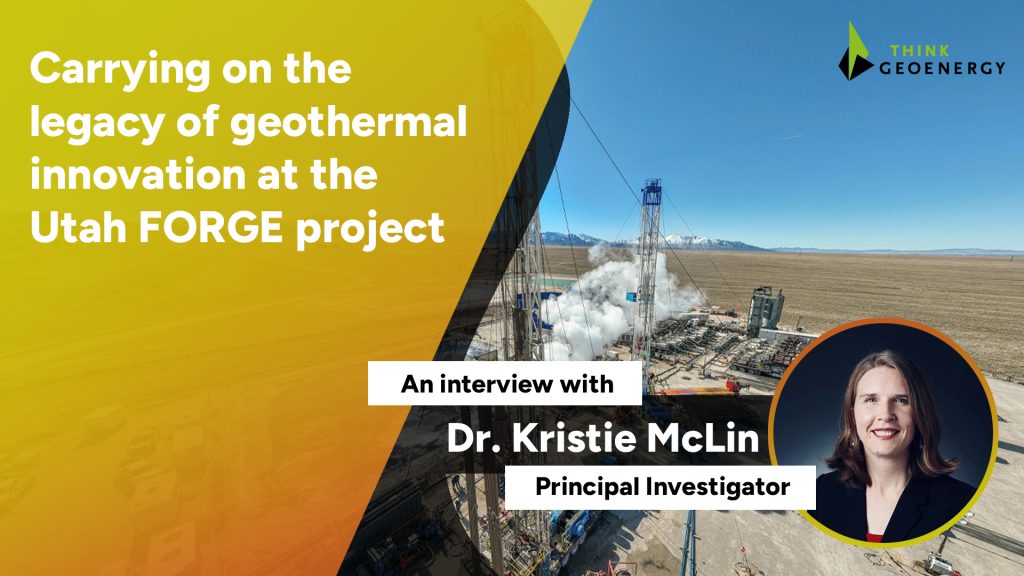
For more than a decade, the Utah Frontier Observatory for Research in Geothermal Energy (Utah FORGE) has served as the world’s premier field laboratory for Enhanced Geothermal Systems (EGS), bringing together government, academia, national laboratories, and private industry to tackle the technical barriers that have long limited geothermal deployment.
Rather than developing a commercial power plant, Utah FORGE was established with a singular mission: to de-risk the technologies, tools, and workflows needed to make EGS commercially viable and replicable at places where suitable geothermal resources exist. With EGS projects now becoming more prominent in the commercial domain, the contributions of Utah FORGE have become an indelible part of the history of its progress.
Recent breakthroughs in drilling, reservoir creation, and long-term circulation testing have demonstrated that engineered geothermal reservoirs can reliably produce heat from hot dry rock, marking a major step toward widespread commercialization. As stated by Dr. Kristie McLin, Principal Investigator of Utah FORGE, the biggest achievement of Utah FORGE is proving that an open research platform can play an important role in accelerating geothermal development at an industrial scale.
Achieving breakthroughs in Enhanced Geothermal Systems
Utah FORGE was created to answer one of the most important questions facing the geothermal industry: can an economically viable geothermal reservoir be engineered in hot, impermeable rock where no natural reservoir exists? Over the past several years, the project has steadily moved from theory to demonstration, delivering several milestones that have reshaped expectations for EGS.
Among the earliest successes came in drilling technology. Drilling has historically represented one of the largest capital costs for geothermal developments, often accounting for more than half of total project startup expenses.
Working in the hard granitic formations beneath Milford, Utah, the FORGE team encountered the limitations of conventional tricone drill bits, which required frequent replacement and prolonged drilling campaigns. By adopting specially modified polycrystalline diamond compact (PDC) drill bits, the project dramatically reduced drilling times and costs, setting new performance records that were later surpassed by commercial operators who adopted similar approaches.
According to Dr. McLin, wells that previously required several months to complete can now be drilled in only a few weeks, illustrating how research conducted at FORGE has already translated into industry-wide improvements.
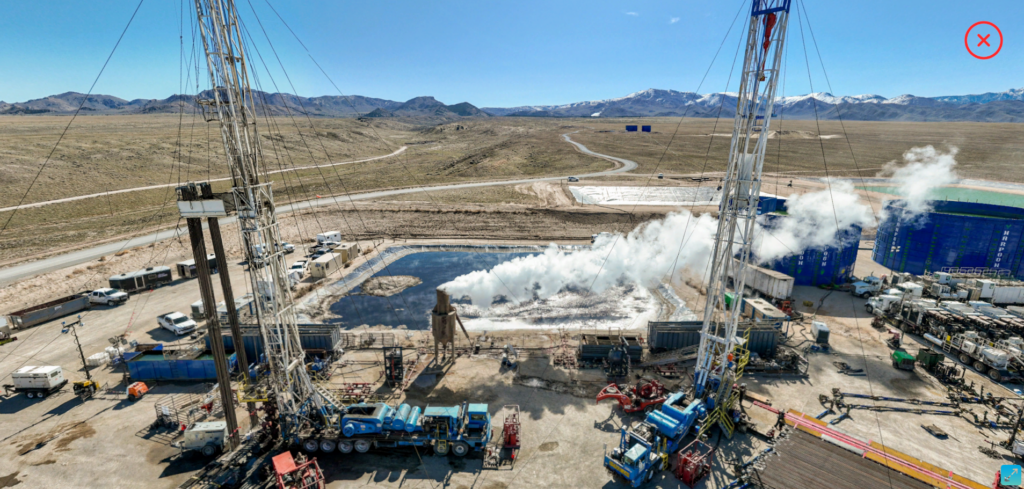
The project’s most significant achievement, however, came in 2024 when Utah FORGE successfully stimulated both its injection and production wells, creating a connected fracture network within hot dry granite. Following the stimulation campaign, engineers conducted a nine-hour circulation test that demonstrated sustained fluid flow and measurable heat transfer between the wells. For the first time at the site, researchers had successfully created a functioning geothermal reservoir where none had naturally existed. This was considered a landmark achievement for engineered geothermal systems.
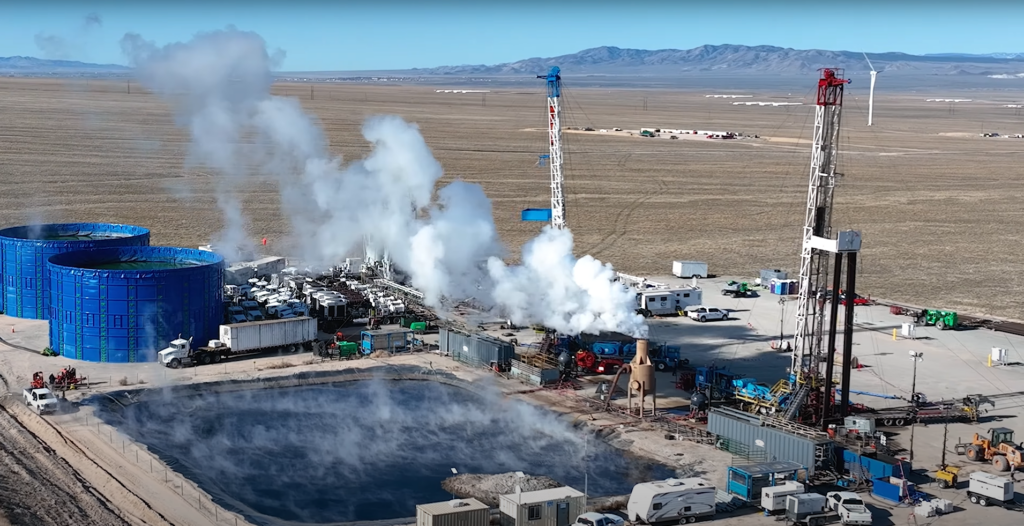
The subsequent commercial-scale circulation test provided even stronger evidence of EGS viability. Conducted over nearly 30 days, the test achieved recovery of almost 90% of the injected fluid while maintaining production temperatures of approximately 370°F (188°C). Such stable temperatures and high recovery rates provided encouraging evidence that engineered reservoirs can sustain long-term heat extraction while minimizing water losses.
Extensive monitoring using fiber-optic sensing, tracers, microseismic measurements, and production logging generated one of the most comprehensive datasets ever assembled for an EGS project. These results not only validated years of research but also provided valuable operational guidance that private developers can apply to future commercial projects.
Dr. McLin emphasized that perhaps the project’s greatest contribution lies in the fact that these technological advances have not remained confined to the research site. Drilling innovations, stimulation strategies, and operational practices developed at Utah FORGE are already being adopted by commercial developers, accelerating learning across the rapidly growing EGS sector.
Charting a path for the future of EGS
Despite the significant milestones already achieved, Utah FORGE’s work is far from complete. With an additional four years of funding from the U.S. Department of Energy through 2028, the project is entering a new phase focused on answering the remaining scientific and engineering questions needed to fully commercialize EGS.
According to Dr. McLin, one of the biggest remaining uncertainties concerns the long-term behavior of engineered reservoirs. While short-term circulation tests have demonstrated excellent connectivity and heat extraction, developers still need better understanding of thermal decline, water losses, scaling, corrosion, and reservoir sustainability over years rather than weeks. These questions directly affect project economics and investor confidence.
To address these challenges, Utah FORGE is preparing for an extended circulation campaign expected to last approximately 90 days, with the possibility of further extension. Operating the reservoir continuously over several months will allow researchers to observe how temperatures evolve under sustained production, how efficiently water is recovered, and how mineral scaling or corrosion develops within the system. The results will provide valuable information for designing future commercial plants capable of operating reliably for decades.
The research team is also exploring the possibility of drilling a third deep deviated well, although planning remains in its early stages. Such an expansion would allow researchers to investigate additional reservoir geometries and optimize well configurations that could improve commercial performance.
Looking beyond Utah, Dr. McLin believes EGS has the potential to dramatically expand geothermal deployment worldwide. The limiting factor is no longer the ability to drill or create reservoirs, but the economics of EGS. Regions with shallow high-temperature resources are currently the most attractive for commercial deployment because drilling costs remain manageable. As drilling technologies continue to improve and costs decline, EGS could also become viable in regions where useful geothermal temperatures occur at much greater depths.
This vision aligns closely with the original purpose of Utah FORGE: developing technologies that eventually make geothermal electricity available almost anywhere. While reaching that goal will require continued reductions in drilling costs and further operational improvements, the progress achieved thus far has been encouraging and suggests that the industry is moving in the right direction.
Dr. McLin also highlighted the continued bipartisan political support geothermal energy enjoys in the United States. She noted that while geothermal development was once largely confined to states with naturally accessible resources such as California, Nevada, and Utah, the interest has significantly broadened across several other states.
Bridging fundamental science and field deployment
One of Utah FORGE’s defining characteristics has been its commitment to open science. Unlike commercial geothermal developments where operational data often remain proprietary, FORGE was designed as a research observatory where data generated from drilling, stimulation, monitoring, and circulation testing are made publicly available for researchers and industry alike. This philosophy has transformed the project into a global learning platform.
As Director of Research and Science at the University of Utah’s Energy & Geoscience Institute (EGI), Dr. McLin sees the institute’s role as helping geothermal evolve from a promising technology into a repeatable commercial energy solution. She believes EGI occupies a unique position by combining world-class expertise in geology, geophysics, geochemistry, reservoir engineering, and drilling with strong partnerships involving national laboratories, federal agencies, and private developers.
Rather than focusing solely on scientific discovery, EGI seeks to answer practical questions that determine whether geothermal projects ultimately succeed. These include identifying the minimum data needed before drilling expensive wells, improving understanding of fractures and stress fields, optimizing well spacing and completions, managing induced seismicity, minimizing water losses, controlling scaling and corrosion, and maintaining reservoir productivity over many years.
Dr. McLin describes EGI as a bridge between fundamental science and field deployment. Advances in geological characterization or reservoir simulation have limited value unless they can be translated into workflows developers can confidently apply in commercial projects. Consequently, Utah FORGE places considerable emphasis on developing practical monitoring strategies, improving risk assessment methodologies, establishing better data standards, and creating integrated workflows that combine multiple scientific disciplines into actionable decision-making tools.
This approach reflects one of Utah FORGE’s greatest legacies. Beyond proving that EGS reservoirs can be engineered, the project has established a collaborative framework where research findings rapidly inform commercial practice, helping shorten the learning curve for the entire geothermal industry.
Other emerging technologies in geothermal
While Enhanced Geothermal Systems remain Dr. McLin’s primary focus, she believes many of the most exciting innovations are occurring in technologies that improve predictability, operational control, and ultimately project bankability.
One area attracting significant attention is the integration of diverse subsurface datasets. Modern geothermal projects generate enormous volumes of information, including well logs, core samples, cuttings, image logs, measurement-while-drilling data, microseismic observations, tracer tests, production logs, geochemical analyses, and stimulation records. The challenge now lies in converting those datasets into better decision-making tools for well placement, reservoir stimulation, production management, and long-term reservoir sustainability.
Reservoir management represents another rapidly evolving field. Successfully creating an engineered reservoir is only the beginning. Maintaining reliable production over decades requires continued advances in high-temperature pumping systems, scaling and corrosion control, water management, and thermal breakthrough prediction. Dr. McLin highlighted technologies such as fiber-optic monitoring, advanced chemical tracers, production logging tools, downhole flow-control devices, and chemistry-based monitoring systems as particularly promising developments that could substantially improve long-term geothermal operations.
She also emphasized the growing importance of digital workflows and data management. Utah FORGE has demonstrated the value of maintaining open, high-quality datasets that enable researchers worldwide to test new models and compare results. Improved data standards, easier data discovery, and better integration between monitoring systems and numerical models may not receive the same attention as breakthrough drilling technologies, but they are essential for accelerating innovation across the geothermal sector.
Collectively, these advances illustrate how geothermal innovation increasingly extends beyond drilling alone. Through monitoring technologies, reservoir management, and data-driven decision making, projects like Utah FORGE are helping transform Enhanced Geothermal Systems from an experimental concept into a practical pathway for expanding the possibilities for geothermal deployment across the world.