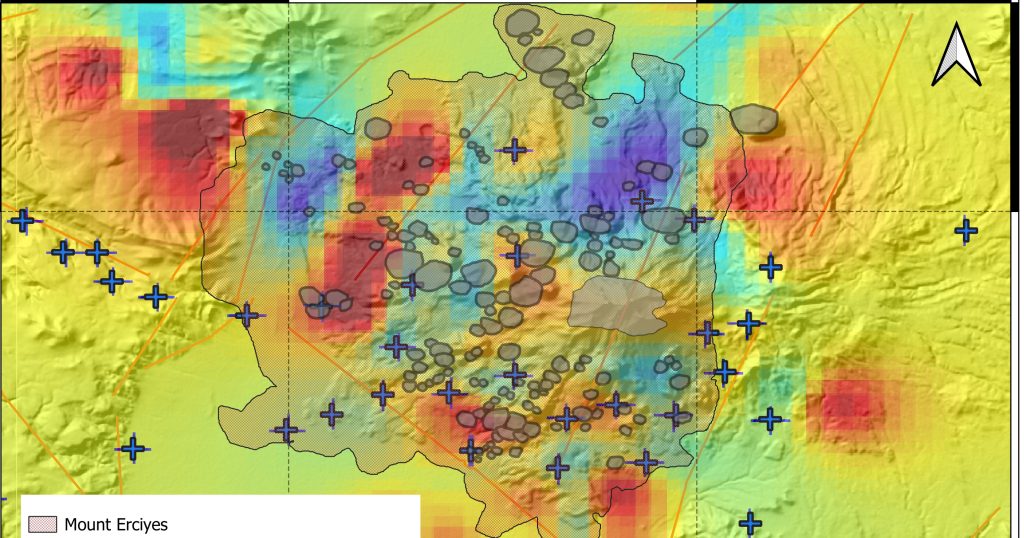
The research conducted by Prof. Dr. Sabri Bülent Tank and colleagues from Bogaziçi University’s Kandilli Observatory and Earthquake Research Institute has been published in the Journal of Volcanology and Geothermal Research. The article, titled “Exposing electrical conductivity anomalies beneath Mount Erciyes, Cappadocia, Turkey,” examines the deep structure of Mount Erciyes in the Cappadocia region and reveals electrical conductivity anomalies.
Analysis of magnetotelluric (MT) data revealed the presence of high conductivity zones beneath the mountain, suggesting that these anomalies may be related to magmatic processes, hydrothermal fluids, or melt presence. The results provide critical information for geothermal energy research, volcanic risk assessment, and regional tectonic evolution. The study is also dedicated to the memory of our valued colleague Serkan Üner, whom we lost at a young age.
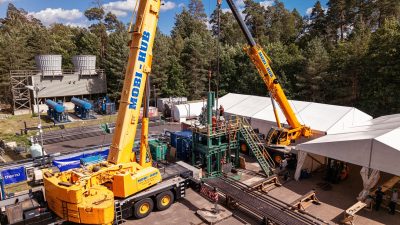
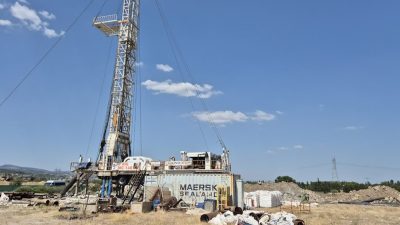
This academic research is directly related to the recent geothermal field projects being conducted around Mount Erciyes. Previously published news in JeotermalHaberler reported that geothermal resource exploration has begun on the slopes of Tekir Plateau and that the MTA has launched geothermal drilling projects.
These studies aim to utilize the hot springs for facilities and tourism investments in the region. It was also stated that drilling conducted by the Kayseri Metropolitan Municipality reached water at a depth of 385 meters with a temperature of 35.9 °C, and that the goal is to reach a depth of 420 meters to find hot water above 50°C. Technical tests on the samples are ongoing, and these findings strongly align with the electrical conductivity anomalies identified in Tank and his team’s study.
Meanwhile, the region’s geothermal potential is being utilized not only for energy and tourism, but also for agricultural production. Work is progressing rapidly on the Geothermal Greenhouse Organized Industrial Zone project, established in the Elmali neighborhood of Kocasinan. Ten wells are planned for the project, with a target temperature of 60°C and a flow rate of 70 liters per second. This initiative demonstrates that the geothermal potential indicated by academic research around Mount Erciyes can be directly translated into economic and social benefits.
In conclusion, the electrical conductivity anomalies discovered deep within Mount Erciyes, combined with geothermal exploration, drilling, and greenhouse projects in the region, offer significant contributions to Türkiye’s vision for sustainable development in energy, agriculture, and tourism. When academic data and field applications are considered together, Erciyes is not only a geological landmark but also on its way to becoming a powerful hub for future geothermal energy.
Source: Email notification via our Turkish language platform JeotermalHaberler